
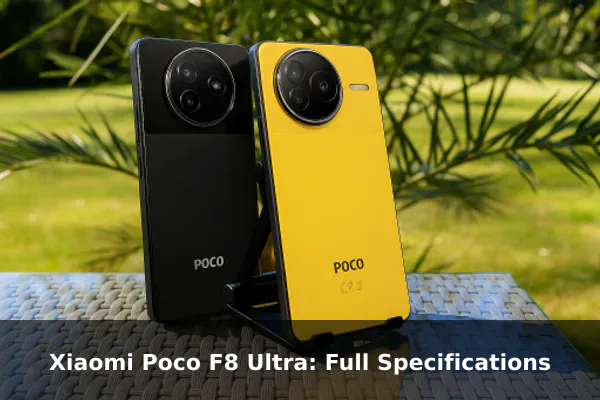
The Xiaomi Poco F8 Ultra is a high-end POCO model built around flagship performance, a large AMOLED display, fast charging, and a more complete camera system than many performance-first phones. Announced and released on November 26, 2025, it sits above the Poco F8 Pro with a bigger screen, a larger battery, wireless charging, and a 5x periscope telephoto camera.
This article focuses on what the specifications mean in real use, not just the numbers. The full specifications table is handled separately, so the analysis below looks at the Poco F8 Ultra as a buying option for users comparing display quality, gaming power, camera flexibility, battery life, audio, and connectivity.
Full Specifications
Network
| Technology: | GSM / HSPA / LTE / 5G |
| 2G bands: | GSM 850 / 900 / 1800 / 1900 |
| 3G bands: | HSDPA 800 / 850 / 900 / 1700(AWS) / 1900 / 2100 |
| 4G bands: | 1, 2, 3, 4, 5, 7, 8, 18, 19, 20, 26, 28, 38, 40, 41, 42, 48, 66, 71 |
| 5G bands: | 1, 2, 3, 5, 7, 8, 20, 26, 28, 38, 40, 41, 48, 66, 71, 77, 78 SA/NSA |
| Speed: | HSPA, LTE, 5G |
Launch
| Announced: | 2025, November 26 |
| Status: | Available. Released 2025, November 26 |
Body
| Dimensions: | 163.3 x 77.8 x 7.9 mm or 8.3 mm |
| Weight: | 218 g or 220 g (7.69 oz) |
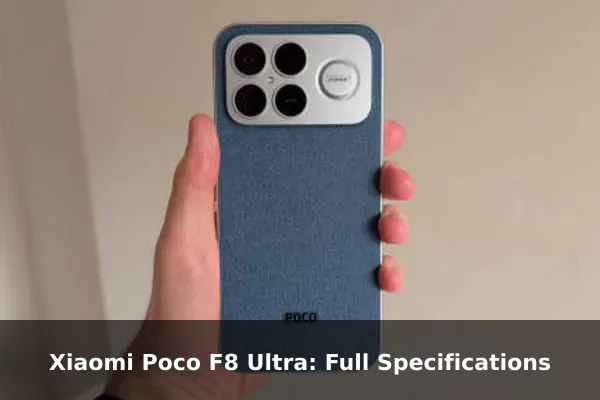
| Build: | Glass front (Poco Shield Glass), aluminum alloy frame, fiber-reinforced plastic back or silicone polymer back |
| SIM: | · Nano-SIM + Nano-SIM + eSIM + eSIM (max 2 at a time)· Nano-SIM + Nano-SIM + eSIM (max 2 at a time) |
| IP68 dust tight and water resistant (immersible up to 1.5m for 30 min) |
Display
| Type: | AMOLED, 68B colors, 2560Hz PWM, 120Hz, Dolby Vision, HDR10+, 2000 nits (HBM), 3500 nits (peak) |
| Size: | 6.9 inches, 116.6 cm2 (~91.8% screen-to-body ratio) |
| Resolution: | 1200 x 2608 pixels, 19.5:9 ratio (~416 ppi density) |
| Protection: | Poco Shield Glass |
Platform
| OS: | Android 16, HyperOS 3 |
| Chipset: | Qualcomm SM8850-AC Snapdragon 8 Elite Gen 5 (3 nm) |
| CPU: | Octa-core (2×4.6 GHz Oryon V3 Phoenix L + 6×3.62 GHz Oryon V3 Phoenix M) |
| GPU: | Adreno 840 |
Memory
| Card slot: | No |
| Internal: | 256GB 12GB RAM, 512GB 16GB RAM |
| UFS 4.1 |
Main Camera
| Triple: | 50 MP, f/1.7, 23mm (wide), 1/1.31″, 1.2µm, dual pixel PDAF, OIS 50 MP, f/3.0, 115mm (periscope telephoto), 1/2.76″, 0.64µm, PDAF (30cm – ∞), OIS, 5x optical zoom 50 MP, f/2.4, 18mm, 102˚ (ultrawide), 1/2.88″, 0.61µm |
| Features: | Color spectrum sensor, LED flash, HDR, panorama |
| Video: | 8K@30fps, 4K@30/60fps, 1080p@30/60/120/240/960fps, 720p@1920fps, gyro-EIS, HDR10+ |
Selfie camera
| Single: | 32 MP, f/2.2, 21mm (wide), 1/3.44″, 0.64µm |
| Features: | HDR |
| Video: | 4K@30fps, 1080p@30/60fps |
Sound
| Loudspeaker: | Yes, with stereo speakers (with Dolby Atmos) |
| 3.5mm jack: | No |
| Tuned by Bose Bose 2.1 stereo sound system with a woofer 24-bit/192kHz Hi-Res & Hi-Res wireless audio |
Comms
| WLAN: | Wi-Fi 802.11 a/b/g/n/ac/6/7, dual-band, Wi-Fi Direct |
| Bluetooth: | 6.0, A2DP, LE, aptX HD, aptX Adaptive, LHDC 5.0, ASHA, MIHC |
| Positioning: | GPS (L1+L5), BDS (B1I+B1c+B2a), GALILEO (E1+E5a), QZSS (L1+L5), NavIC (L5), GLONASS |
| NFC: | Yes (market/region dependent) |
| Infrared port: | Yes |
| Radio: | No |
| USB: | USB Type-C 3.2, Display Port, OTG |
Features
| Sensors: | Fingerprint (under display, ultrasonic), accelerometer, proximity, gyro, compass |
Battery
| Type: | 6500 mAh |
| Charging: | 100W wired, PD3.0, QC3+, 100W PPS, 100% in 38 mins 50W wireless, 50% in 31 mins 22.5W reverse wireless |
Misc
| Colors: | Black, White, Denim Blue |
| Models: | 25102PCBEG |
| Price: | € 829.90 / £ 749.00 |
Our Tests
| Performance: | AnTuTu: 2720760 (v10), 3887841 (v11) GeekBench: 10876 (v6) 3DMark: 6864 (Wild Life Extreme) |
| Display: | 1077 nits max brightness (measured) |
| Loudspeaker: | -26.0 LUFS (Very good) |
| Battery: | Active use score 18:52h |
Price and Availability
The Xiaomi Poco F8 Ultra offers a compelling combination of features and performance. While the base price is around €830, the actual cost may vary depending on your location and retailer. Below, you’ll find the approximate price of the Xiaomi Poco F8 Ultra converted into various currencies. Please note that these are estimates based on recent exchange rates as of August 23, 2026 and may not reflect the exact price you’ll find at a retailer.
- United States: $969
- Japan: ¥154,046
- United Kingdom: £711
- Australia: A$1,355
- Canada: C$1,334
- Taiwan: NT$30,870
- Denmark: kr6.204
- Saudi Arabia: ﷼3,636
- South Korea: ₩1,344,913
- Germany: €830
- Brazil: R$5.037
- Vietnam: ₫25.327.608
- Kenya: KSh 125,540
- India: ₹92,861
- Indonesia: Rp 17.154.533
- Nigeria: ₦1,316,647
- Pakistan: ₨269,045
- Philippines: ₱59,871
- Bangladesh: ৳১,১৮,৪৪০
Why Should You Buy the Xiaomi Poco F8 Ultra?
The Poco F8 Ultra makes the most sense for buyers who want flagship-grade hardware without moving fully into ultra-premium pricing territory. Its strongest pitch is balance: Snapdragon 8 Elite Gen 5 performance, a 6.9-inch AMOLED panel, 6500mAh battery capacity, 100W wired charging, 50W wireless charging, IP68 protection, and a triple 50MP rear camera setup. Many Poco phones have focused heavily on speed, but this model adds features that matter outside gaming, including a periscope zoom camera, USB 3.2 with DisplayPort, ultrasonic fingerprint unlocking, eSIM support, and a Bose-tuned 2.1 speaker system.
The main trade-off is that this is not a small or lightweight phone. At 218g or 220g depending on the finish, it is clearly built for users who prioritize screen size, battery, cooling room, and multimedia hardware over one-handed comfort. It also lacks a microSD slot and a 3.5mm headphone jack, so buyers should be comfortable with internal storage and wireless or USB-C audio.
Design and Durability
The Poco F8 Ultra uses a glass front protected by Poco Shield Glass, an aluminum alloy frame, and either a fiber-reinforced plastic back or a silicone polymer back depending on the variant. The design is more rugged and premium than the average mid-range Poco, helped by IP68 dust and water resistance. That rating is useful for accidental exposure to rain or freshwater, although it should still be treated as laboratory-tested protection rather than permission to use the phone at the beach, in pools, or while charging when wet.
Its dimensions place it firmly in large flagship territory. The 163.3mm height and 77.8mm width make it better suited to two-handed use, while the 7.9mm or 8.3mm thickness keeps the body reasonably slim for a phone with this battery size. The dual nano-SIM and eSIM combinations are flexible, but only two lines can be active at once, and eSIM availability remains dependent on carrier and region.
Display and Media Experience
The display is one of the Poco F8 Ultra’s defining features. The 6.9-inch AMOLED panel supports 68 billion colors, a 120Hz refresh rate, Dolby Vision, HDR10+, 2560Hz PWM dimming, and a 1200 x 2608 resolution at about 416ppi. That combination points to a screen made for games, streaming, browsing, and long sessions, with enough pixel density to look sharp despite the large size.
Official brightness claims reach 2000 nits in high-brightness mode and 3500 nits peak, while the measured test figure supplied in the source data is 1077 nits maximum brightness. That distinction matters: peak brightness figures usually apply to limited screen areas and specific HDR or lab conditions, while measured brightness is more useful for everyday readability. For media, the Dolby Vision and HDR10+ support are backed by stereo speakers with Dolby Atmos and a Bose-tuned 2.1 system with a woofer, giving the phone a stronger entertainment angle than most performance-oriented Poco models.
Performance and Storage
The Snapdragon 8 Elite Gen 5 is the core reason to consider this phone. Built on a 3nm process and paired with an Adreno 840 GPU, it uses two high-performance Oryon V3 Phoenix L cores running up to 4.6GHz and six Oryon V3 Phoenix M cores running up to 3.62GHz. In practical terms, this is aimed at demanding games, heavy multitasking, high-refresh browsing, video editing, and long-term performance headroom.
The source test scores underline that positioning: AnTuTu reaches 2,720,760 in v10 and 3,887,841 in v11, while GeekBench 6 is listed at 10,876 and 3DMark Wild Life Extreme at 6,864. Storage options are straightforward: 256GB with 12GB RAM or 512GB with 16GB RAM, both using UFS 4.1. Because there is no card slot, the 512GB version is the safer choice for users who record lots of 4K or 8K video, keep large games installed, or store offline media.
Camera System
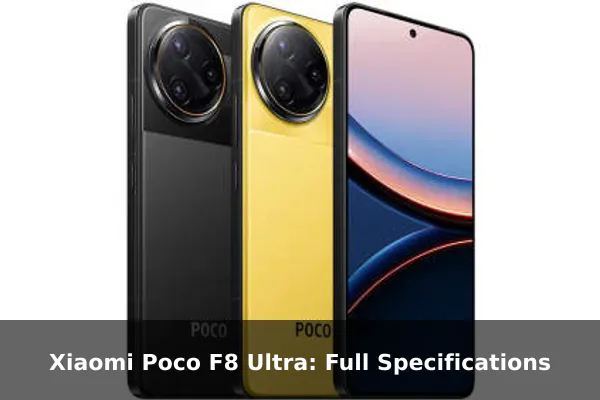
The triple rear camera system is more versatile than the typical speed-focused gaming phone. The main camera uses a 50MP sensor with a 23mm wide lens, f/1.7 aperture, dual pixel PDAF, and OIS. That is the everyday camera for people, food, indoor scenes, and night shots. The 50MP periscope telephoto camera adds 5x optical zoom at a 115mm equivalent focal length, also with PDAF and OIS, which is important for portraits, distant subjects, stage shots, and travel details.
The third rear camera is a 50MP ultrawide with an 18mm lens and 102-degree field of view. It is useful for landscapes, architecture, interiors, and group photos, although the smaller sensor details suggest expectations should stay realistic in low light. Video support is extensive, including 8K at 30fps, 4K at 30 or 60fps, high-frame-rate 1080p modes, gyro-EIS, and HDR10+. The 32MP front camera also supports 4K at 30fps, making it stronger than many selfie cameras for vlogging and video calls.
Battery and Charging
The 6500mAh battery is a major advantage for users who push their phones hard. The supplied active use score of 18 hours and 52 minutes suggests very strong endurance, especially for a phone with a large 120Hz AMOLED display and flagship chipset. Battery life will still depend on screen brightness, 5G usage, gaming load, camera recording, and navigation, but the capacity gives the Poco F8 Ultra more room than many slim flagships.
Charging is equally aggressive. The phone supports 100W wired charging with PD3.0, QC3+, and 100W PPS, with a claimed full charge in 38 minutes. It also supports 50W wireless charging, listed at 50 percent in 31 minutes, plus 22.5W reverse wireless charging. The practical value is flexibility: fast top-ups at a desk, cable-free charging at night, and emergency reverse charging for earbuds or another compatible device.
Software and Security
The Poco F8 Ultra ships with Android 16 and HyperOS 3. That gives it Xiaomi’s latest interface layer for this generation, with the usual mix of Android features, Xiaomi ecosystem tools, customization, performance controls, and region-dependent software services. As always with manufacturer skins, buyers should check local firmware behavior, preinstalled apps, and update policy in their market before purchase.
For biometric security, the phone uses an ultrasonic fingerprint sensor under the display. Ultrasonic sensors generally aim to improve speed and reliability compared with basic optical scanners, particularly when the display or finger is slightly damp, though real-world results depend on implementation. The sensor set also includes accelerometer, proximity, gyro, and compass hardware, covering the expected motion, navigation, gaming, and orientation needs.
Connectivity and Ports
Connectivity is broad. The Poco F8 Ultra supports GSM, HSPA, LTE, and 5G with a wide band list, including SA and NSA 5G. It also includes Wi-Fi 7, Bluetooth 6.0, NFC depending on market, infrared, multi-system positioning, and USB Type-C 3.2 with DisplayPort and OTG. That USB setup is a real advantage for users who transfer large files, connect external storage, or want wired display output.
The audio and wireless codec list is also unusually rich, with aptX HD, aptX Adaptive, LHDC 5.0, ASHA, and MIHC listed alongside Dolby Atmos and Hi-Res audio support. There is no FM radio and no headphone jack, but the overall package is clearly built around modern wireless audio and USB-C accessories. The loudspeaker test result of -26.0 LUFS is rated very good in the supplied data, which supports the phone’s media-first identity.
Who Should Buy the Poco F8 Ultra?
Buy the Poco F8 Ultra if you want flagship performance, a very large screen, long battery life, fast wired and wireless charging, stronger-than-average speakers, and a camera setup that includes real optical zoom. It is especially appealing for mobile gamers who also care about movies, navigation, photography, and everyday productivity.
Skip it if you want a compact phone, expandable storage, a headphone jack, or the lightest possible daily device. Users who mostly take casual photos and do not need gaming-class performance may also find better value in less expensive models. The Poco F8 Ultra is best understood as a performance flagship with extra multimedia depth, not a minimal or budget-focused phone.
Conclusion
The Xiaomi Poco F8 Ultra is one of POCO’s most complete flagship-style phones, combining top-tier Snapdragon performance with a large AMOLED display, IP68 protection, a 6500mAh battery, 100W wired charging, 50W wireless charging, a 5x periscope camera, and Bose-tuned audio. Its size, lack of microSD support, and missing headphone jack are the main compromises. For buyers who want a powerful Android phone with serious battery, display, camera, and speaker hardware, it is an easy recommendation.
References
- POCO Global – POCO F8 Ultra Specs – Primary specification sheet for processor, memory, dimensions, display, cameras, battery, charging, bands, sensors, audio, OS, and package contents.
- Xiaomi Global – POCO F8 Ultra Product Page – Official product overview with key feature claims, footnotes, lab-test caveats, IP68 notes, camera and display details.
- Xiaomi Global – POCO F8 Series Global Launch Event – Official launch context for announcement timing, product positioning, launch highlights, and initial availability/open-sale details.
- Qualcomm Snapdragon 8 Series Mobile Platforms – Primary chipset reference for Snapdragon 8 Elite Gen 5 platform details that can verify processor-related claims.
- Notebookcheck – Affordable flagship with Bose subwoofer: Xiaomi Poco F8 Ultra review – Reputable technical review source useful for cross-checking measured display, performance, thermals, battery life, connectivity, and real-world hardware behavior.
