
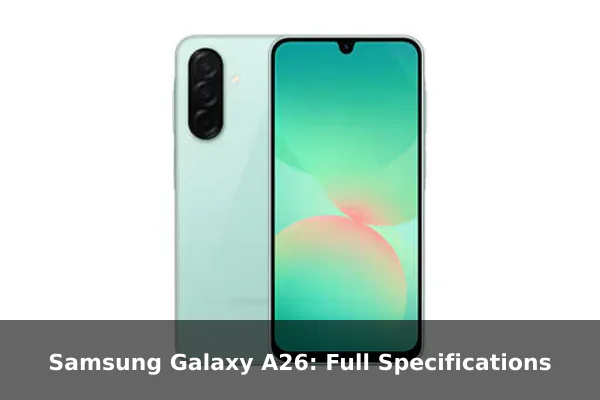
The Samsung Galaxy A26 is a mid-range 5G phone built around the practical things many buyers check first: a large AMOLED screen, long software support, water resistance, a 5000 mAh battery, and a main camera with optical image stabilization.
Its strongest angle is not raw gaming power or premium materials everywhere, but the way it combines durability-minded hardware, Samsung’s update promise, and broad network support at a lower price tier than the Galaxy A3x and A5x models.
Full Specifications
Network
| Technology: | GSM / HSPA / LTE / 5G |
| 2G bands: | GSM 850 / 900 / 1800 / 1900 |
| 3G bands: | HSDPA 850 / 900 / 1700(AWS) / 1900 / 2100 |
| 4G bands: | 1, 2, 3, 4, 5, 7, 8, 12, 17, 20, 26, 28, 32, 38, 40, 41, 66 |
| 5G bands: | 1, 3, 5, 7, 8, 20, 28, 38, 40, 41, 66, 77, 78 SA/NSA/Sub6 |
| Speed: | HSPA, LTE, 5G |
Launch
| Announced: | 2025, March 02 |
| Status: | Available. Released 2025, March 19 |
Body
| Dimensions: | 164 x 77.5 x 7.7 mm (6.46 x 3.05 x 0.30 in) |
| Weight: | 200 g (7.05 oz) |
| Build: | Glass front (Gorilla Glass Victus+), plastic frame, glass back (Gorilla Glass Victus+) |
| SIM: | Nano-SIM + Nano-SIM |
| IP67 dust/water resistant (up to 1m for 30 min) |
Display
| Type: | Super AMOLED, 120Hz |
| Size: | 6.7 inches, 110.2 cm2 (~86.7% screen-to-body ratio) |
| Resolution: | 1080 x 2340 pixels, 19.5:9 ratio (~385 ppi density) |
| Protection: | Corning Gorilla Glass Victus+, Mohs level 5 |
Platform
| OS: | Android 15, up to 6 major Android upgrades, One UI 7 |
| Chipset: | Exynos 1380 (5 nm) – GlobalExynos 1280 (5 nm) – LATAM |
| CPU: | Octa-core (4×2.4 GHz Cortex-A78 & 4×2.0 GHz Cortex-A55) – GlobalOcta-core (2×2.4 GHz Cortex-A78 & 6×2.0 GHz Cortex-A55) – LATAM |
| GPU: | Mali-G68 MP5 – GlobalMali-G68 – LATAM |
Memory
| Card slot: | microSDXC (uses shared SIM slot) |
| Internal: | 128GB 4GB RAM, 128GB 6GB RAM, 128GB 8GB RAM, 256GB 6GB RAM, 256GB 8GB RAM |
Main Camera
| Triple: | 50 MP, f/1.8, 27mm (wide), 1/2.76″, 0.64µm, PDAF, OIS 8 MP, f/2.2, 120˚ (ultrawide), 1/4.0″, 1.12µm 2 MP, f/2.4, (macro) |
| Features: | LED flash, panorama, HDR |
| Video: | 4K@30fps, 1080p@30fps, 720p@480fps, gyro-EIS |
Selfie camera
| Single: | 13 MP, f/2.2, (wide), 1/3.06″, 1.12µm |
| Video: | 1080p@30fps |
Sound
| Loudspeaker: | Yes |
| 3.5mm jack: | No |
Comms
| WLAN: | Wi-Fi 802.11 a/b/g/n/ac, dual-band, Wi-Fi Direct |
| Bluetooth: | 5.3, A2DP, LE |
| Positioning: | GPS, GALILEO, GLONASS, BDS, QZSS |
| NFC: | Yes (market/region dependent) |
| Radio: | Unspecified |
| USB: | USB Type-C 2.0, OTG |
Features
| Sensors: | Fingerprint (side-mounted), accelerometer, gyro, compass |
| Virtual proximity sensing Circle to Search |
Battery
| Type: | 5000 mAh |
| Charging: | 25W wired |
Misc
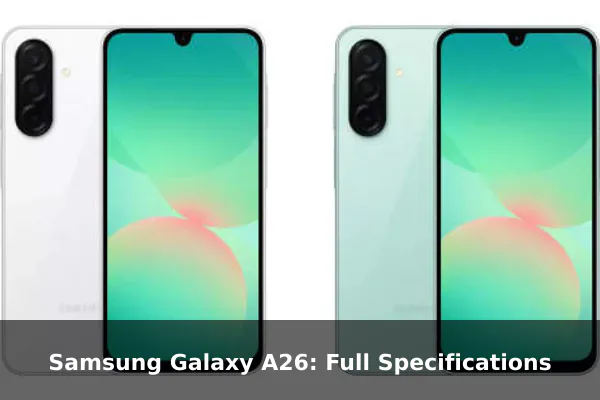
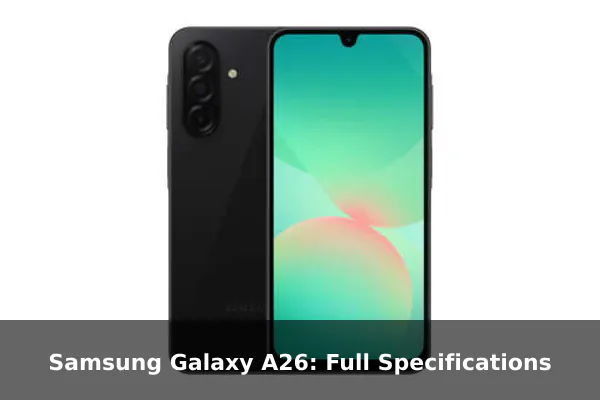
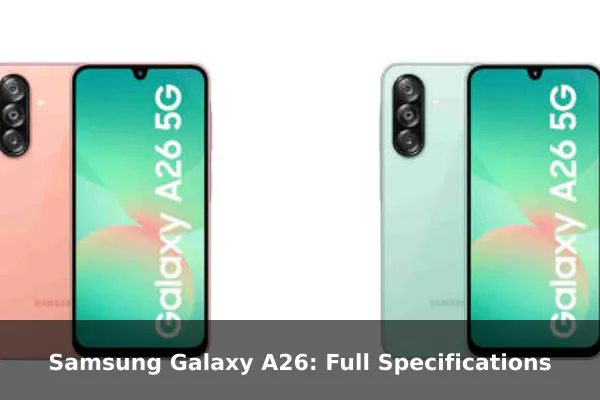
| Colors: | Black, White, Mint, Peach Pink |
| Models: | SM-A266E, SM-A266E/DS, SM-A266E/DSN, SM-A266B, SM-A266B/DS, SM-A266B/DSN, SM-A266U, SM-A266U1 |
| SAR: | 0.75 W/kg (head) 1.09 W/kg (body) |
| SAR EU: | 0.41 W/kg (head) 0.96 W/kg (body) |
| Price: | € 193.90 / $ 199.50 / £ 163.00 / ₹ 20,200 |
Our Tests
| Performance: | AnTuTu: 579811 (v10) GeekBench: 2768 (v6) 3DMark: 794 (Wild Life Extreme) |
| Display: | 777 nits max brightness (measured) |
| Loudspeaker: | -27.1 LUFS (Good) |
| Battery: | Active use score 10:44h |
EU LABEL
| Energy: | Class C |
| Battery: | 37:05h endurance, 1200 cycles |
| Free fall: | Class B (269 falls) |
| Repairability: | Class C |
Price and Availability
The Samsung Galaxy A26 offers a compelling combination of features and performance. While the base price is around €194, the actual cost may vary depending on your location and retailer. Below, you’ll find the approximate price of the Samsung Galaxy A26 converted into various currencies. Please note that these are estimates based on recent exchange rates as of September 20, 2026 and may not reflect the exact price you’ll find at a retailer.
- United States: $223
- Japan: ¥34,973
- United Kingdom: £166
- Australia: A$313
- Canada: C$311
- Taiwan: NT$7,079
- Denmark: kr1.450
- Saudi Arabia: ﷼835
- South Korea: ₩308,462
- Germany: €194
- Brazil: R$1.143
- Vietnam: ₫5.789.629
- Kenya: KSh 28,793
- India: ₹21,327
- Indonesia: Rp 3.949.570
- Nigeria: ₦302,913
- Pakistan: ₨61,769
- Philippines: ₱13,968
- Bangladesh: ৳২৭,৩১৯
Value Position
The Galaxy A26 sits in a very competitive part of the Android market, where buyers usually have to choose between speed, camera quality, battery life, software support, and build protection. Samsung’s pitch here is balance. You get 5G, a 120Hz Super AMOLED display, IP67 dust and water resistance, Gorilla Glass Victus+ on the front and back, and a long update policy, all without moving into flagship pricing. The raw price data places it around the budget-to-lower-midrange bracket, although real local pricing can vary by region, retailer, memory configuration, and promotions.
For readers comparing it with older Galaxy A-series models, the A26 feels most meaningful as a durability and support upgrade. It is not simply a basic phone with 5G added; the combination of IP67 protection, OIS on the main camera, and six major Android upgrades gives it a longer practical lifespan than many inexpensive alternatives.
Image note 1: Use a clean front-and-back product image showing the Black, White, Mint, and Peach Pink color options when available.
Design And Durability
The phone measures 164 x 77.5 x 7.7 mm and weighs 200 g, so it is large but reasonably slim for a device with a 6.7-inch screen and 5000 mAh battery. The plastic frame reminds you that this is not a premium Galaxy S model, but the glass front and glass back with Gorilla Glass Victus+ are notable at this level. The IP67 rating is also a major everyday advantage because it protects against dust and immersion in up to 1 meter of water for 30 minutes under rated test conditions.
The side-mounted fingerprint sensor is a practical choice. It keeps unlocking fast and familiar, especially for users who prefer a physical touch point over an in-display reader. The dual Nano-SIM setup is useful, but storage expansion uses the shared SIM slot, so buyers who need two SIMs and a microSD card at the same time should check that trade-off carefully.
Display Experience
The 6.7-inch Super AMOLED panel is one of the Galaxy A26’s headline features. It offers a 1080 x 2340 resolution, a tall 19.5:9 aspect ratio, and a 120Hz refresh rate, making it well suited for scrolling, video, messaging, maps, and casual gaming. The measured 777 nits maximum brightness from the supplied test data is solid for daily use, though it should not be confused with the extreme peak brightness figures seen on expensive flagship phones.
Samsung’s AMOLED tuning usually favors strong contrast and punchy colors, which helps streaming and social media feel more vivid. Gorilla Glass Victus+ protection and the listed Mohs level 5 result add reassurance, but a case and screen protector still make sense for buyers planning to keep the phone for several years.
Performance And Chipset Notes
Performance depends partly on region. The global version is listed with the Exynos 1380, while the LATAM version uses the Exynos 1280. Both are 5 nm chips, but they are not identical, so shoppers should verify the exact model sold in their market if chipset performance matters. The supplied benchmark figures, including an AnTuTu v10 score of 579811, a GeekBench v6 score of 2768, and a 3DMark Wild Life Extreme score of 794, point to capable everyday performance rather than enthusiast-grade gaming power.
For messaging, browsing, video calls, banking apps, streaming, and light editing, the Galaxy A26 should feel comfortably responsive, especially with the 120Hz display. The 4GB RAM base version is the one to approach cautiously. If the price difference is reasonable, the 6GB or 8GB RAM versions are better long-term choices, particularly because Samsung is promising years of software upgrades.
Camera Setup
The rear camera system is led by a 50 MP wide camera with PDAF and OIS. Optical stabilization is the most important part of that sentence because it helps with handshake in lower light and improves the odds of sharper still images. The 8 MP ultrawide camera adds useful flexibility for landscapes, buildings, and group shots, while the 2 MP macro camera is more of an occasional close-up tool than a reason to buy the phone.
Video recording reaches 4K at 30fps, with 1080p at 30fps and 720p slow motion up to 480fps listed. Gyro-EIS is included for video stabilization. The 13 MP front camera records 1080p video at 30fps, which is adequate for selfies, social clips, and video calls. Overall, this is a practical camera system for the price class, strongest on the stabilized main sensor and less impressive on secondary lenses.
Image note 2: Use a lifestyle image showing the Galaxy A26 display and rear camera module in natural lighting, ideally without heavy filters.
Battery Life And Charging
The 5000 mAh battery is exactly what most buyers expect from a modern Samsung mid-range phone. The supplied active use score of 10:44h suggests dependable all-day performance for mixed use, while the EU label endurance figure of 37:05h and 1200-cycle battery rating add useful context for long-term ownership. Actual endurance will still depend on brightness, signal strength, gaming, camera use, and whether 5G is active throughout the day.
Charging is rated at 25W wired. That is serviceable but not class-leading, especially compared with some Chinese-brand competitors that charge much faster. The trade-off is that Samsung is emphasizing predictable battery behavior and longevity rather than headline charging speed.
Software And Longevity
The Galaxy A26 ships with Android 15 and One UI 7, with support for up to six major Android upgrades. This is one of the phone’s most important selling points. In a lower-cost phone, long software support can matter more than a small benchmark difference because it helps keep the device usable, secure, and feature-relevant for longer.
Samsung also includes Circle to Search and the usual One UI ecosystem benefits. Buyers already using Galaxy Buds, Galaxy Watch, Samsung account backup, Smart Switch, or other Samsung services will find the A26 easier to fit into an existing setup than many similarly priced alternatives.
Connectivity And Everyday Features
Network support is broad, with GSM, HSPA, LTE, and Sub-6 5G bands listed, including SA and NSA 5G operation. Wi-Fi 802.11 a/b/g/n/ac, Bluetooth 5.3, NFC depending on market, USB-C 2.0 with OTG, and multi-system positioning support are included. The absence of a 3.5mm headphone jack may disappoint wired-audio users, but it is now common in this segment.
The speaker test result of -27.1 LUFS is marked as good in the supplied data. The phone has a loudspeaker, but buyers who care about immersive media should still check whether the local model’s speaker behavior meets their expectations. For navigation, payments, pairing accessories, and general connectivity, the A26 covers the essentials well.
Who Should Buy It
The Galaxy A26 makes the most sense for buyers who want a dependable Samsung phone with a big AMOLED display, 5G, solid battery life, water resistance, expandable storage, and unusually long Android version support for the price. It is also a sensible pick for students, family buyers, and business users who value predictable software maintenance more than flashy charging speeds or gaming-focused hardware.
It is less ideal for users who want the fastest possible chipset, premium metal construction, wireless charging, a headphone jack, or high-end zoom cameras. If those features matter, a higher Galaxy A-series model or a discounted flagship may be a better fit.
References
Reference sources used for verification include the official Samsung UK Galaxy A26 5G specifications page, the Samsung Global Newsroom launch announcement, and the supplied catalog source from tampungspekhp.berkasdrive.com.
Conclusion
The Samsung Galaxy A26 is a well-rounded 5G phone for buyers who care about display quality, durability, battery life, and long software support more than flagship speed. Choose the 6GB or 8GB RAM version if pricing is close; it is the recommended configuration for longer use.
