
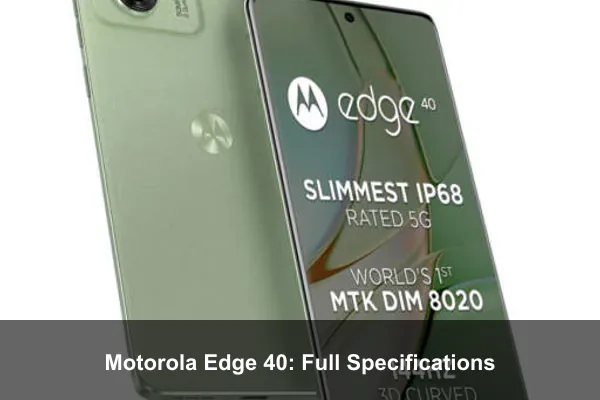
Motorola Edge 40 targets buyers who want a premium-feeling phone without stepping into ultra-flagship pricing. Instead of chasing extreme hardware numbers, it focuses on practical balance: slim body, strong display quality, capable cameras, and fast charging.
For specs-focused readers, this model stands out as a lightweight 5G option with IP68 protection, wireless charging, and Ready For support in a segment where those features are still uncommon together.
Full Specifications
Network
| Technology: | GSM / HSPA / LTE / 5G |
| 2G bands: | GSM 850 / 900 / 1800 / 1900 |
| 3G bands: | HSDPA 850 / 900 / 1700(AWS) / 1900 / 2100 |
| 4G bands: | 1, 2, 3, 4, 5, 7, 8, 12, 13, 17, 20, 26, 28, 32, 38, 39, 40, 41, 42, 43, 66 |
| 5G bands: | 1, 2, 3, 5, 7, 8, 20, 28, 38, 40, 41, 66, 77, 78 SA/NSA/Sub6 |
| Speed: | HSPA, LTE (CA), 5G |
Launch
| Announced: | 2023, May 04 |
| Status: | Available. Released 2023, May 04 |
Body
| Dimensions: | 158.4 x 72 x 7.6 mm (6.24 x 2.83 x 0.30 in) |
| Weight: | 167 g or 171 g (5.89 oz) |
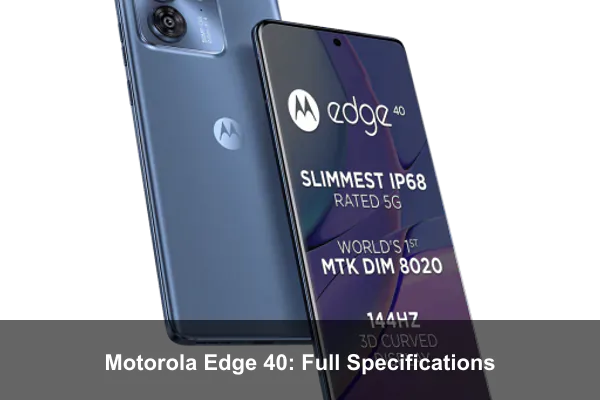
| Build: | Glass front, aluminum frame, plastic back or eco leather back |
| SIM: | Nano-SIMNano-SIM + eSIMNano-SIM + Nano-SIM |
| IP68 dust tight and water resistant (immersible up to 1.5m for 30 min) |
Display
| Type: | P-OLED, 144Hz, HDR10+, 1200 nits (peak) |
| Size: | 6.55 inches, 103.6 cm2 (~90.8% screen-to-body ratio) |
| Resolution: | 1080 x 2400 pixels, 20:9 ratio (~402 ppi density) |
Platform
| OS: | Android 13, up to 2 major Android upgrades |
| Chipset: | Mediatek Dimensity 8020 (6 nm) |
| CPU: | Octa-core (4×2.6 GHz Cortex-A78 & 4×2.0 GHz Cortex-A55) |
| GPU: | Mali-G77 MC9 |
Memory
| Card slot: | No |
| Internal: | 128GB 8GB RAM, 256GB 8GB RAM |
| UFS 3.1 |
Main Camera
| Dual: | 50 MP, f/1.4, (wide), 1/1.55″, 1.0µm, multi-directional PDAF, OIS 13 MP, f/2.2, 120˚ (ultrawide), 1/3.0″, 1.12µm, AF |
| Features: | Dual-LED flash, HDR, panorama |
| Video: | 4K@30fps, 1080p@30/60/120fps, 720p@960fps, HDR10, gyro-EIS |
Selfie camera
| Single: | 32 MP, f/2.4, (wide), 1/3.0″, 0.7µm |
| Features: | HDR |
| Video: | 4K@30fps, 1080p@30/120fps |
Sound
| Loudspeaker: | Yes, with stereo speakers |
| 3.5mm jack: | No |
Comms
| WLAN: | Wi-Fi 802.11 a/b/g/n/ac/6e, tri-band, Wi-Fi Direct |
| Bluetooth: | 5.2, A2DP, LE |
| Positioning: | GPS, GLONASS, GALILEO, BDS |
| NFC: | Yes |
| Radio: | No |
| USB: | USB Type-C 2.0, OTG |
Features
| Sensors: | Fingerprint (under display, optical), accelerometer, gyro, proximity, compass |
| Smart Connect (Ready For) support |
Battery
| Type: | Li-Po 4400 mAh |
| Charging: | 68W wired 15W wireless |
Misc
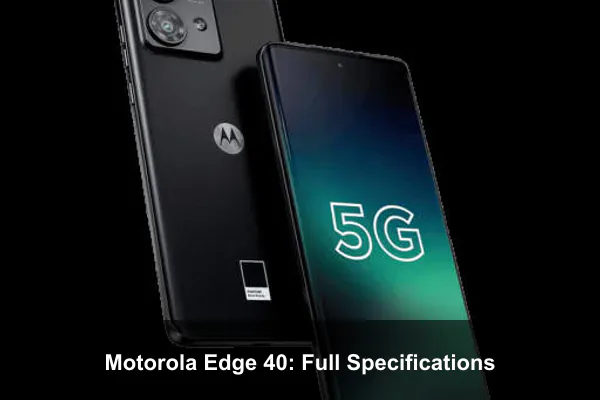
| Colors: | Nebula Green, Lunar Blue, Eclipse Black, Viva Magenta |
| Models: | XT2303-2 |
| Price: | € 210.09 / $ 419.99 / £ 230.07 / ₹ 29,999 |
Our Tests
| Performance: | AnTuTu: 688347 (v9) GeekBench: 3320 (v5.1), 3603 (v6) GFXBench: 33fps (ES 3.1 onscreen) |
| Display: | 1043 nits max brightness (measured) |
| Camera: | Photo / Video |
| Loudspeaker: | -24.2 LUFS (Very good) |
| Battery (old): | Endurance rating 98h |
Price and Availability
The Motorola Edge 40 offers a compelling combination of features and performance. While the base price is around €210, the actual cost may vary depending on your location and retailer. Below, you’ll find the approximate price of the Motorola Edge 40 converted into various currencies. Please note that these are estimates based on recent exchange rates as of April 24, 2026 and may not reflect the exact price you’ll find at a retailer.
- United States: $246
- Japan: ¥39,211
- United Kingdom: £182
- Australia: A$344
- Canada: C$336
- Taiwan: NT$7,753
- Denmark: kr1.568
- Saudi Arabia: ﷼921
- South Korea: ₩363,855
- Germany: €210
- Brazil: R$1.220
- Vietnam: ₫6.411.766
- Kenya: KSh 31,763
- India: ₹23,119
- Indonesia: Rp 4.248.465
- Nigeria: ₦330,163
- Pakistan: ₨68,479
- Philippines: ₱14,844
- Bangladesh: ৳৩০,১৩৫
Value Position in 2023 Flagship-Lite Class
The Edge 40 is best viewed as a feature-dense upper mid-range phone. Compared with many similarly priced devices, it combines premium extras like IP68 durability and wireless charging, giving it better day-to-day value than phones that only prioritize chipset benchmarks.
Design and Build Practicality
At 7.6 mm thick and around 167 g to 171 g, the phone is notably easy to handle for long sessions. The aluminum frame plus glass or eco-leather back options also let buyers choose between a more classic finish and a grippier, less fingerprint-prone texture.
Display Experience for Daily Use
The 6.55-inch P-OLED panel with 144Hz refresh rate and HDR10+ delivers smooth scrolling and strong contrast. With high measured brightness, visibility is dependable outdoors, making it a strong panel for both media and gaming-focused users.
Performance and Thermal Expectations
Dimensity 8020 performance is comfortably in the range needed for multitasking, social apps, and demanding games at sensible settings. UFS 3.1 storage helps with app loading speed, and overall results indicate consistent real-world responsiveness rather than short burst-only performance.
Camera Strengths and Limits
The 50MP main camera with OIS and a bright lens is the clear highlight, especially for low-light and handheld shots. The 13MP ultrawide adds flexibility and autofocus usefulness, while 4K support on both rear and selfie cameras is a practical advantage for content creators.
Battery and Charging Balance
The 4400 mAh battery is moderate on paper but paired with efficient hardware it delivers solid endurance. Fast 68W wired charging reduces downtime, and 15W wireless charging adds convenience that many competitors in this tier still skip.
Software Lifecycle and User Experience
It ships with Android 13 and receives up to two major Android upgrades. That policy is adequate but not class-leading, so long-term software-focused buyers should weigh this against brands offering longer update commitments.
Connectivity and Ecosystem Utility
Broad 5G support, Wi-Fi 6e, NFC, and dual-SIM/eSIM flexibility make the connectivity package well-rounded for international and power users. Smart Connect (Ready For) support is especially useful if you want a desktop-style workflow from your phone.
Who Should Buy Motorola Edge 40
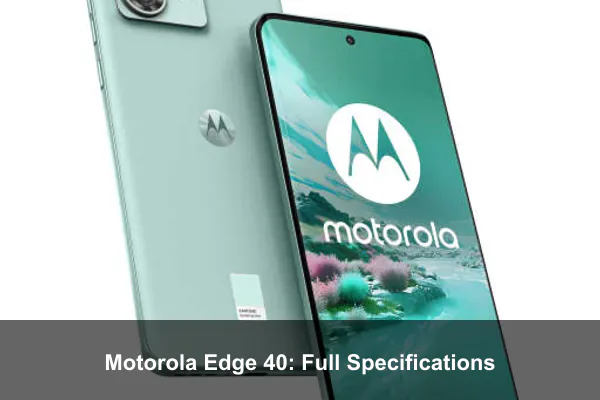
This phone is ideal for users who prioritize comfort, display quality, camera reliability, and fast charging over chasing top-tier silicon. If you want a lighter premium-feel 5G device with practical flagship-like extras, the Edge 40 is a smart choice.
Conclusion
Motorola Edge 40 delivers one of the most balanced all-around packages in its class, combining premium design touches, a strong display, reliable cameras, and flexible charging. It is an easy recommendation for buyers who value daily usability and feature completeness over pure benchmark prestige.
