
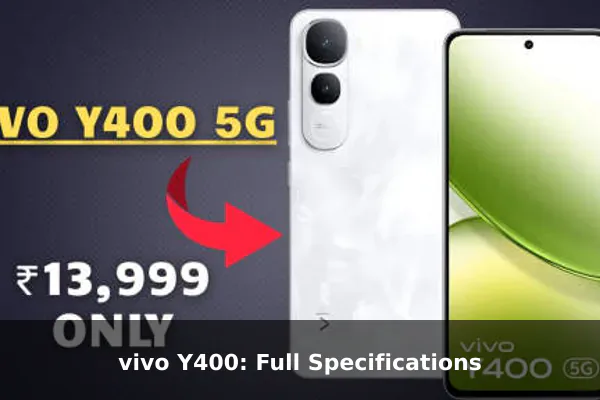
The vivo Y400 is a durability-focused Android phone built around a large AMOLED display, a 6000 mAh battery, fast wired charging, and modern 5G network support. It sits in the practical mid-range space where long battery life, everyday smoothness, and weather resistance matter more than flagship camera extras.
Based on the supplied specification sheet, the standout mix is clear: a 120Hz AMOLED panel, Snapdragon 4 Gen 2 hardware, 8GB RAM, UFS 3.1 storage, IP68/IP69 protection, and a 50MP main camera. This article focuses on what those specifications mean in real buying terms, while the full technical table is handled separately.
Full Specifications
Network
| Technology: | GSM / HSPA / LTE / 5G |
| 2G bands: | GSM 850 / 900 / 1800 / 1900 |
| 3G bands: | HSDPA 800 / 850 / 900 / 2100 |
| 4G bands: | 1, 3, 4, 5, 8, 18, 19, 26, 28, 38, 40, 41, 42, 48 |
| 5G bands: | 1, 3, 5, 8, 28, 40, 77, 78 SA/NSA |
| Speed: | HSPA, LTE, 5G |
Launch
| Announced: | 2025, August 04 |
| Status: | Available. Released 2025, August 07 |
Body
| Dimensions: | 162.3 x 75.3 x 7.9 mm (6.39 x 2.96 x 0.31 in) |
| Weight: | 197 g (6.95 oz) |
| Build: | Glass front, plastic back, plastic frame |
| SIM: | Nano-SIM + Nano-SIM |
| IP68/IP69 dust tight and water resistant (high pressure water jets; immersible up to 2m for 30 min) MIL-STD-810H compliant* * does not guarantee ruggedness or use in extreme conditions |
Display
| Type: | AMOLED, 120Hz, 1200 nits (HBM), 1800 nits (peak) |
| Size: | 6.67 inches, 107.4 cm2 (~87.9% screen-to-body ratio) |
| Resolution: | 1080 x 2400 pixels, 20:9 ratio (~395 ppi density) |
Platform
| OS: | Android 15, Funtouch 15 |
| Chipset: | Qualcomm SM4450 Snapdragon 4 Gen 2 (4 nm) |
| CPU: | Octa-core (2×2.2 GHz Cortex-A78 & 6×1.95 GHz Cortex-A55) |
| GPU: | Adreno 613 |
Memory
| Card slot: | Unspecified |
| Internal: | 128GB 8GB RAM, 256GB 8GB RAM |
| UFS 3.1 |
Main Camera
| Dual: | 50 MP, f/1.8, (wide), 1/2.96″, PDAF 2 MP, f/2.4, (depth) |
| Features: | Ring-LED flash, panorama, HDR |
| Video: | 1080p@30fps |
Selfie camera
| Single: | 32 MP, f/2.5, (wide) |
| Video: | 1080p@30fps |
Sound
| Loudspeaker: | Yes, with stereo speakers |
| 3.5mm jack: | No |
| 24-bit/192kHz Hi-Res audio |
Comms
| WLAN: | Wi-Fi 802.11 a/b/g/n/ac, dual-band |
| Bluetooth: | 5.0, A2DP, LE |
| Positioning: | GPS, GLONASS, GALILEO, BDS, QZSS |
| NFC: | No |
| Radio: | No |
| USB: | USB Type-C 2.0, OTG |
Features
| Sensors: | Fingerprint (under display, optical), accelerometer, gyro, proximity, compass |
| Circle to Search |
Battery
| Type: | Li-Ion 6000 mAh |
| Charging: | 90W wired, 50% in 20 min Reverse wired Bypass Charging |
Misc
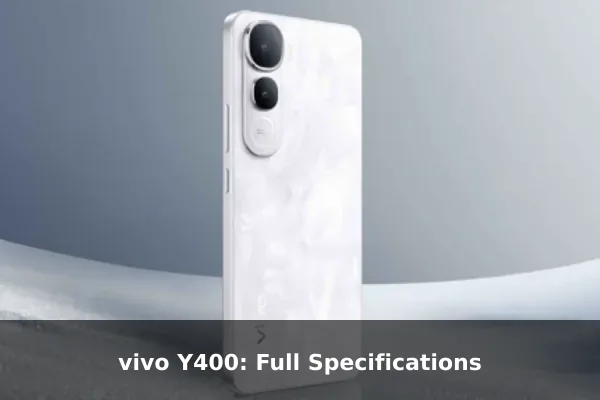
| Colors: | Glam White, Olive Green |
| SAR: | 0.99 W/kg (head) 0.80 W/kg (body) |
| Price: | ₹ 21,999 |
Price and Availability
The vivo Y400 offers a compelling combination of features and performance. While the base price is around ₹21,999, the actual cost may vary depending on your location and retailer. Below, you’ll find the approximate price of the vivo Y400 converted into various currencies. Please note that these are estimates based on recent exchange rates as of July 28, 2026 and may not reflect the exact price you’ll find at a retailer.
- United States: $229
- Japan: ¥37,554
- United Kingdom: £172
- Australia: A$328
- Canada: C$324
- Taiwan: NT$7,409
- Denmark: kr1.504
- Saudi Arabia: ﷼860
- South Korea: ₩336,634
- Germany: €202
- Brazil: R$1.168
- Vietnam: ₫6.016.874
- Kenya: KSh 29,668
- India: ₹21,999
- Indonesia: Rp 4.142.310
- Nigeria: ₦313,021
- Pakistan: ₨63,704
- Philippines: ₱14,150
- Bangladesh: ৳২৮,৩০২
Why Should You Buy the vivo Y400?
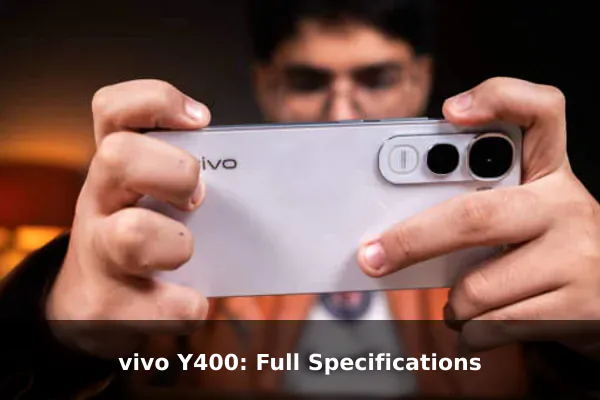
The vivo Y400 makes the most sense for buyers who want a phone that feels dependable before it feels flashy. Its strongest points are not unusual gimmicks, but core features that affect daily use: a large AMOLED display, a high-capacity battery, fast charging, stereo speakers, and dust and water resistance. That combination gives it a practical identity among mid-range Android phones.
The supplied data also points to 5G support, which is important for buyers planning to keep a phone for several years. With Android 15 and Funtouch 15 out of the box, the Y400 starts from a modern software base rather than feeling like a late-cycle budget model. The value story is strongest if your priorities are display quality, battery endurance, durability, and clean everyday performance.
Design and Durability
The phone measures 162.3 x 75.3 x 7.9 mm and weighs 197 g, so it is fairly slim for a device carrying a 6000 mAh battery. The glass front, plastic back, and plastic frame are expected choices in this segment, helping keep weight and cost under control while still allowing a polished exterior finish.
Its IP68/IP69 rating is one of the more important design details. The supplied specification describes dust-tight protection, resistance to high-pressure water jets, and immersion protection up to 2 meters for 30 minutes. The MIL-STD-810H compliance note should be read carefully: it does not make the phone indestructible, but it does suggest the Y400 is positioned as tougher than a typical thin mid-range handset. Buyers who use a phone outdoors, while commuting, or around water will appreciate that extra margin.
Display Quality
The 6.67-inch AMOLED display is a major part of the Y400’s appeal. A 1080 x 2400 resolution gives it a sharp 20:9 layout at roughly 395 ppi, which is suitable for streaming, browsing, reading, and social apps. The 120Hz refresh rate should also make scrolling and supported animations feel smoother than standard 60Hz panels.
Brightness is another strong point. The panel is listed at 1200 nits in high-brightness mode and 1800 nits peak, which should help outdoor visibility and HDR-style highlights in supported content. Since not every app or scene will use peak brightness or 120Hz all the time, these figures are best understood as capability limits rather than constant operating levels.
Performance and Storage
The Snapdragon 4 Gen 2 chipset is built for efficient mainstream performance rather than heavy flagship gaming. Its octa-core CPU combines two Cortex-A78 performance cores with six Cortex-A55 efficiency cores, while the Adreno 613 GPU handles graphics. For everyday apps, messaging, browsing, navigation, video playback, and casual games, this hardware profile is well matched to the Y400’s role.
The memory setup is more encouraging than the chipset tier might suggest. Both listed variants include 8GB RAM, and storage options are 128GB and 256GB. UFS 3.1 storage is a meaningful advantage because faster storage can improve app loading, file handling, and overall responsiveness compared with slower eMMC or older UFS implementations. The card slot is unspecified, so buyers should choose internal storage carefully.
Camera Setup
The rear camera system is simple: a 50MP wide camera with PDAF and a 2MP depth sensor. This is a familiar mid-range arrangement, with the main camera doing almost all the real photographic work and the depth sensor supporting portrait separation. Features such as HDR, panorama, and a Ring-LED flash add flexibility, but there is no listed ultrawide or telephoto camera.
Video recording is capped at 1080p at 30fps on both rear and front cameras, which is acceptable for casual clips but not ideal for buyers who want 4K capture or higher frame-rate video. The 32MP front camera is one of the more notable camera specifications, especially for selfies, video calls, and social media use. The Y400 is therefore better viewed as a dependable everyday camera phone than a creator-focused camera device.
Battery and Charging
The 6000 mAh battery is one of the clearest reasons to consider the vivo Y400. That capacity gives it a strong foundation for long daily endurance, especially when paired with an efficient mid-range chipset. Actual battery life will still depend on brightness, 5G use, gaming, navigation, and camera activity, but the hardware clearly favors longevity.
Charging is also strong, with 90W wired charging listed and a 50% charge claim in 20 minutes. Reverse wired charging adds emergency usefulness for accessories or another phone, while bypass charging is valuable for users who play games or use the phone plugged in for longer sessions because it can reduce unnecessary battery strain in supported scenarios.
Software and Features
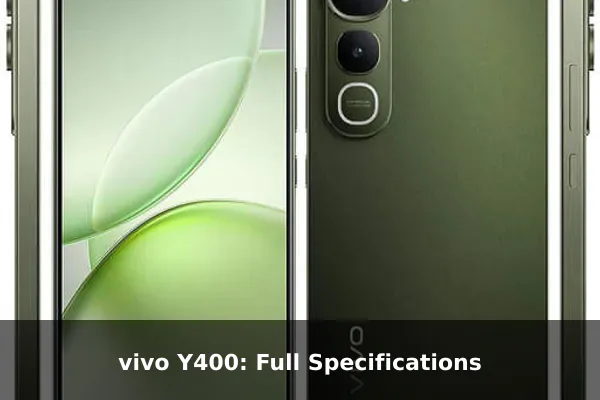
The phone ships with Android 15 and Funtouch 15, giving it a current Android base and vivo’s familiar interface layer. Buyers who already use vivo phones should find the experience familiar, while new users should expect a feature-rich Android skin rather than a stock Android layout.
The feature list includes an under-display optical fingerprint sensor, accelerometer, gyro, proximity sensor, and compass. Circle to Search is also listed, giving the Y400 a modern AI-assisted search feature that can be useful for identifying items, text, or visual content directly from the screen.
Connectivity and Audio
Network support is broad, covering GSM, HSPA, LTE, and 5G with both SA and NSA 5G bands listed. That makes the Y400 more future-ready than a 4G-only phone, though real-world availability depends on carrier support, region, and band compatibility. Dual Nano-SIM support is useful for users managing personal and work numbers or mixing carriers.
Wireless connectivity includes dual-band Wi-Fi, Bluetooth 5.0, and major satellite positioning systems such as GPS, GLONASS, GALILEO, BDS, and QZSS. NFC and FM radio are not listed, so contactless payment users should check regional requirements before buying. For audio, stereo speakers and 24-bit/192kHz Hi-Res audio support are welcome, but the lack of a 3.5mm headphone jack means wired headphone users will need USB-C audio or an adapter.
Who Should Buy the vivo Y400?
The vivo Y400 is best suited to users who want a balanced Android phone with strong battery life, a bright AMOLED screen, 5G support, and unusually serious ingress protection for its class. It is a good match for commuters, students, field workers, and general users who value reliability over premium camera versatility.
It is less ideal for buyers who need an ultrawide camera, 4K video recording, NFC, a headphone jack, or flagship-level gaming performance. Those limitations do not make the Y400 weak, but they define its lane clearly: this is a practical long-lasting phone, not a compact flagship replacement or camera-first device.
Conclusion
The vivo Y400 offers a strong mix of durability, display quality, battery capacity, fast charging, and everyday Android performance. Its simple camera system and missing NFC are worth noting, but for buyers prioritizing endurance, AMOLED visuals, 5G, and water resistance, the vivo Y400 is easy to recommend.
References
- vivo Indonesia Y400 Specifications – Official manufacturer specification page for the vivo Y400, covering chipset, display, battery, cameras, dimensions, network bands, software, and variants.
- vivo Indonesia Y400 Product Page – Official product overview for vivo Y400 features such as AMOLED 120Hz display, IP68/IP69 rating, battery, camera positioning, and design claims.
- vivo Indonesia Y400 Launch News – Official launch announcement with release timing, market positioning, memory variants, and introductory pricing for Indonesia.
- vivo Bangladesh Y400 Specifications – Official English-language vivo Y400 specification page useful for cross-checking global specs and wording in an English article.
- vivo India Y400 5G Product Page – Official source for the separate vivo Y400 5G variant, useful to avoid mixing 4G Y400 specs with the 5G model.
