
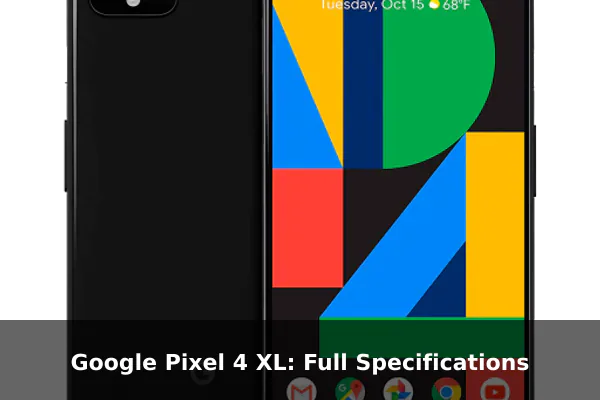
Google Pixel 4 XL is the larger 2019 Pixel flagship, built around a QHD+ OLED screen, Snapdragon 855 performance, dual rear cameras, and Google’s clean Android software approach.
This article looks at the Pixel 4 XL from a modern specs-buying angle: how its big display, LTE-only connectivity, face unlock hardware, and Android 13 upgrade ceiling affect its value today.
Full Specifications
Network
| Technology: | GSM / CDMA / HSPA / EVDO / LTE |
| 2G bands: | GSM 850 / 900 / 1800 / 1900 |
| CDMA 800 / 1900 | |
| 3G bands: | HSDPA 850 / 900 / 1700(AWS) / 1900 / 2100 |
| CDMA2000 1xEV-DO | |
| 4G bands: | 1, 2, 3, 4, 5, 7, 8, 12, 13, 17, 20, 25, 26, 28, 32, 38, 39, 40, 41, 66, 71 – Global |
| 1, 2, 3, 4, 5, 7, 8, 12, 13, 14, 17, 18, 19, 20, 25, 26, 28, 29, 30, 38, 39, 40, 41, 46, 48, 66, 71 – USA | |
| Speed: | HSPA 42.2/5.76 Mbps, LTE (5CA) Cat18 1200/150 Mbps |
Launch
| Announced: | 2019, October 15 |
| Status: | Available. Released 2019, October 22 |
Body
| Dimensions: | 160.4 x 75.1 x 8.2 mm (6.31 x 2.96 x 0.32 in) |
| Weight: | 193 g (6.81 oz) |
| Build: | Glass front (Gorilla Glass 5), glass back (Gorilla Glass 5), aluminum frame |
| SIM: | Nano-SIM + eSIM |
| IP68 dust tight and water resistant (immersible up to 1.5m for 30 min) |
Display
| Type: | P-OLED, 90Hz, HDR |
| Size: | 6.3 inches, 98.0 cm2 (~81.3% screen-to-body ratio) |
| Resolution: | 1440 x 3040 pixels, 19:9 ratio (~537 ppi density) |
| Protection: | Corning Gorilla Glass 5 |
Platform
| OS: | Android 10, upgradable to Android 13 |
| Chipset: | Qualcomm SM8150 Snapdragon 855 (7 nm) |
| CPU: | Octa-core (1×2.84 GHz Kryo 485 & 3×2.42 GHz Kryo 485 & 4×1.78 GHz Kryo 485) |
| GPU: | Adreno 640 |
Memory
| Card slot: | No |
| Internal: | 64GB 6GB RAM, 128GB 6GB RAM |
| UFS 2.1 |
Main Camera
| Dual: | 12.2 MP, f/1.7, 27mm (wide), 1/2.55″, 1.4µm, dual pixel PDAF, OIS 16 MP, f/2.4, 50mm (telephoto), 1/3.6″, 1.0µm, PDAF, OIS, 2x optical zoom |
| Features: | Dual-LED flash, Pixel Shift, Auto-HDR, panorama |
| Video: | 4K@30fps, 1080p@30/60/120fps, 1080p@30fps (gyro-EIS) |
Selfie camera
| Single: | 8 MP, f/2.0, 22mm (wide), 1.22µm, no AF TOF 3D, (depth/biometrics sensor) |
| Features: | HDR |
| Video: | 1080p@30fps |
Sound
| Loudspeaker: | Yes, with stereo speakers |
| 3.5mm jack: | No |
Comms
| WLAN: | Wi-Fi 802.11 a/b/g/n/ac, dual-band, Wi-Fi Direct, DLNA |
| Bluetooth: | 5.0, A2DP, LE, aptX HD |
| Positioning: | GPS, GLONASS, BDS, GALILEO |
| NFC: | Yes |
| Radio: | No |
| USB: | USB Type-C 3.1 |
Features
| Sensors: | Face ID, accelerometer, gyro, proximity, compass, barometer |
Battery
| Type: | Li-Po 3700 mAh, non-removable |
| Charging: | 18W wired, PD2.0 Wireless |
Misc
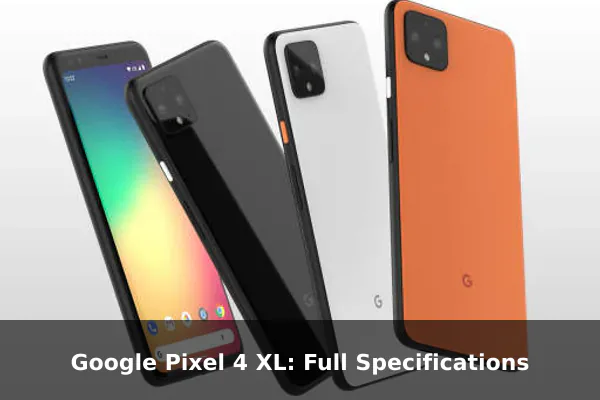
| Colors: | Clearly White, Just Black, Oh So Orange |
| Models: | G020P, G020, GA01181-US, GA01182-US, GA01180-US |
| Price: | About 180 EUR |
Our Tests
| Performance: | AnTuTu: 323305 (v7), 403267 (v8) GeekBench: 10171 (v4.4), 2267 (v5.1) GFXBench: 21fps (ES 3.1 onscreen) |
| Camera: | Photo / Video |
| Loudspeaker: | Voice 80dB / Noise 78dB / Ring 88dB |
| Audio quality: | Noise -93.9 / Crosstalk -94.1 |
| Battery (old): | Endurance rating 73h |
Price and Availability
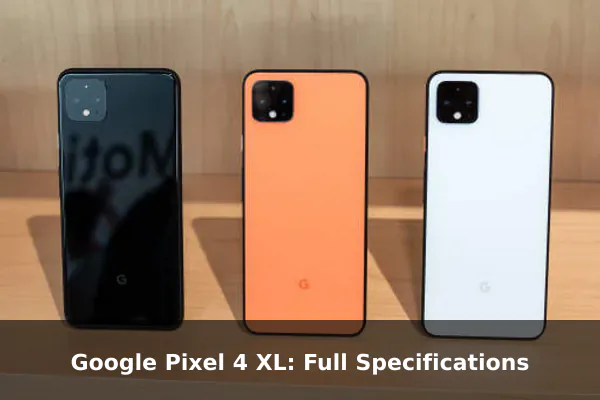
The Google Pixel 4 XL offers a compelling combination of features and performance. While the base price is around €180, the actual cost may vary depending on your location and retailer. Below, you’ll find the approximate price of the Google Pixel 4 XL converted into various currencies. Please note that these are estimates based on recent exchange rates as of August 28, 2026 and may not reflect the exact price you’ll find at a retailer.
- United States: $210
- Japan: ¥33,417
- United Kingdom: £154
- Australia: A$292
- Canada: C$291
- Taiwan: NT$6,649
- Denmark: kr1.345
- Saudi Arabia: ﷼786
- South Korea: ₩289,589
- Germany: €180
- Brazil: R$1.080
- Vietnam: ₫5.463.366
- Kenya: KSh 27,145
- India: ₹20,034
- Indonesia: Rp 3.718.968
- Nigeria: ₦284,115
- Pakistan: ₨58,271
- Philippines: ₱12,972
- Bangladesh: ৳২৫,৮৪০
Why Should You Buy Google Pixel 4 XL?
The Google Pixel 4 XL makes the most sense for buyers who want an older premium Pixel at a low second-hand or remaining-stock price, rather than a brand-new mid-range phone. Its appeal is not based on having the newest modem, the biggest battery, or the longest update promise. Instead, it offers a high-resolution OLED display, dependable still photography, stereo speakers, wireless charging, IP68 protection, and Google’s straightforward Android interface in a phone that originally launched as a flagship.
The key value angle is that the Pixel 4 XL feels more premium than many budget phones in build, screen sharpness, haptics, and camera processing. The trade-off is equally clear: there is no 5G, no microSD slot, no headphone jack, and official platform updates stop at Android 13. Buyers should treat it as a polished LTE Pixel for everyday use, photography, media, and app basics, not as a long-term update-first purchase.
Design and Build Quality
Pixel 4 XL uses a glass-and-aluminum body with Gorilla Glass 5 on the front and back. At 193 g, it has the weight of a large flagship without becoming unusually heavy, and the 8.2 mm profile keeps it reasonably slim. The design is more functional than flashy: a squared camera island, matte-style color choices depending on finish, and a front layout shaped by the sensors required for face unlock and Motion Sense.
Durability is one of its stronger points for a used-phone buyer. The IP68 rating means the phone was designed for dust resistance and water immersion under stated test conditions, although water resistance can weaken with age, repairs, drops, or worn seals. Anyone buying a used unit should still inspect the frame, back glass, USB-C port, and any signs of previous repair before relying on that rating.
Display Experience
The 6.3-inch P-OLED panel is one of the reasons the XL model remains interesting. It combines a 1440 x 3040 resolution, about 537 ppi density, HDR support, and a 90 Hz refresh rate. That gives it a sharper and smoother feel than many basic phones, especially when reading text, browsing, scrolling settings, or watching high-quality video.
The display is also the main distinction from smaller, cheaper older Pixels. The QHD+ resolution is excellent for detail, and the 19:9 shape gives the phone a tall but familiar hand feel. The screen-to-body ratio is not modern by 2026 standards because the top sensor area is larger than punch-hole designs, but the practical viewing quality remains strong. Buyers who care more about panel sharpness than all-screen styling will understand the appeal quickly.
Performance and Hardware
The Snapdragon 855 and Adreno 640 were flagship components in 2019, and they still provide enough power for messaging, browsing, navigation, streaming, photography, and many games at moderate settings. The benchmark figures in the source data, including AnTuTu and GeekBench results, put it clearly above entry-level hardware from the same era and still competitive with some lower-cost phones for general responsiveness.
The bigger limitation is not raw CPU speed but memory and storage flexibility. Pixel 4 XL comes with 6 GB of RAM and either 64 GB or 128 GB of internal storage using UFS 2.1. There is no card slot, so the 64 GB model should be approached carefully if you store lots of video, offline maps, large apps, or camera files. For most buyers today, the 128 GB version is the safer target.
Camera Performance
The rear camera system pairs a 12.2 MP wide camera with optical stabilization and a 16 MP telephoto camera with 2x optical zoom. This is a different philosophy from many modern phones that add ultrawide or macro cameras for spec-sheet breadth. Pixel 4 XL focuses on the main camera, portrait processing, zoom quality, HDR, Night Sight-style low-light photography, and Google’s computational image pipeline.
For still photos, that approach can still work well. The wide camera has dual pixel autofocus, OIS, and large enough pixels to produce clean everyday shots, while the telephoto lens is useful for portraits and closer framing. Video is more limited by current standards because rear 4K recording tops out at 30 fps, and the front camera records up to 1080p at 30 fps. Buyers focused on still photography will be happier than users who want modern 4K60 video or ultrawide flexibility.
Battery and Charging
The 3700 mAh battery is larger than the standard Pixel 4 battery, which is an important reason to choose the XL model. The source endurance rating of 73 hours suggests acceptable but not outstanding stamina for its generation. In real ownership today, battery health matters more than the original capacity number. A used Pixel 4 XL with a worn cell can feel very different from one with a recently replaced battery.
Charging is practical rather than fast by modern standards. The phone supports 18 W wired charging with USB Power Delivery 2.0 and also supports wireless charging. That is convenient for desk or bedside use, but shoppers coming from recent Android phones with very high wattage charging should expect slower top-ups. Battery-conscious buyers should also remember that the QHD+ 90 Hz display can draw more power than a basic 60 Hz panel.
Software and Security
Pixel 4 XL launched with Android 10 and is listed as upgradeable to Android 13. That gives it a clean and mature Android experience, with Pixel features such as fast camera access, Google services integration, and a generally uncluttered interface. The Pixel Neural Core and Titan M security hardware were also part of Google’s flagship positioning for this generation.
The important caution is update status. Because this is an older Pixel, it should not be purchased with the expectation of the same long software runway offered by newer Pixel models. Android 13 is still usable for many apps, but users who require ongoing feature updates, the longest security support, or enterprise-grade lifecycle planning should look at a newer Pixel instead.
Connectivity and Everyday Features
Connectivity is broad for LTE. The Pixel 4 XL supports GSM, CDMA, HSPA, EVDO, and LTE, with extensive 4G band coverage that differs by global and U.S. model. It also includes Wi-Fi 802.11 a/b/g/n/ac, Bluetooth 5.0 with aptX HD support, NFC, multi-system positioning, and USB Type-C 3.1. Nano-SIM plus eSIM support adds flexibility, depending on carrier and region.
The main omission is 5G. For buyers in strong LTE areas, that may not matter much for calls, maps, social apps, and streaming. For users who plan to keep a phone for years on a 5G-heavy carrier plan, it is a real limitation. The phone also skips FM radio and the 3.5 mm headphone jack, so wired audio needs USB-C or an adapter.
Who Should Buy This Phone?
Google Pixel 4 XL is best for users who want an affordable older flagship with a sharp display, reliable Pixel still photography, stereo speakers, wireless charging, and compact software without heavy manufacturer skins. It is also a better pick than the smaller Pixel 4 for people who care about screen size and battery capacity.
It is not the right choice for buyers who need 5G, expandable storage, a fresh update policy, very fast charging, or a modern multi-camera setup with ultrawide video options. The smartest buyer is someone who understands the age of the device, chooses the 128 GB model if possible, checks battery health carefully, and values the Pixel camera experience more than having the newest spec sheet.
Conclusion
Google Pixel 4 XL remains a distinctive older flagship: sharp QHD+ 90 Hz display, clean Android software, strong still cameras, wireless charging, and IP68 build quality, balanced against no 5G, limited storage options, and an Android 13 update ceiling. Buy it only at a suitably low price and preferably in the 128 GB version with healthy battery condition.
References
- Google Pixel Phone Help – Pixel phone hardware tech specs (earlier models) – Official Google hardware specifications for Pixel 4 XL, including display, dimensions, battery, memory, processor, cameras, sensors, ports, wireless connectivity, network bands, colors, and update notes.
- Google Pixel Phone Help – Safety & regulatory manual for Pixel 4 and Pixel 4 XL – Official regulatory and safety documentation for Pixel 4 XL, useful for model identifiers, conformity declarations, safety notes, and water-resistance/regulatory claims.
- Google Blog – Pixel 4 is here to help – Official launch announcement with release timing, launch pricing, colors, and key Pixel 4 series features such as Motion Sense, camera upgrades, Android 10, 6 GB RAM, 90 Hz display, Pixel Neural Core, and Titan M.
- Qualcomm – Snapdragon 855 Mobile Platform – Official processor reference for the Snapdragon 855 used in the Pixel 4 XL, including CPU, GPU, modem, connectivity, camera ISP, and platform capabilities.
- GSMArena – Google Pixel 4 XL specifications – Well-known device specifications database useful as a secondary cross-check for full spec tables, launch status, variants, network bands, and camera/video details.
