
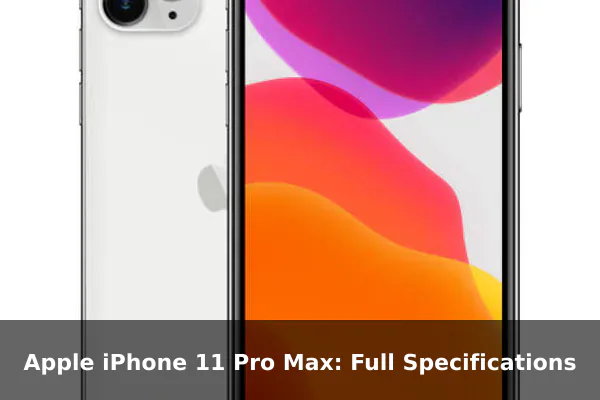
The Apple iPhone 11 Pro Max remains one of the most interesting older flagship iPhones because it combines the largest 2019 Pro display, the A13 Bionic chip, a triple-camera system, and unusually strong battery endurance for its generation.
This specifications-focused overview looks beyond the table data to explain where the iPhone 11 Pro Max still makes sense, what its hardware strengths are, and which limitations matter most when comparing it with newer iPhones or current Android alternatives.
Full Specifications
Network
| Technology: | GSM / CDMA / HSPA / EVDO / LTE |
| 2G bands: | GSM 850 / 900 / 1800 / 1900 |
| CDMA 800 / 1900 | |
| 3G bands: | HSDPA 850 / 900 / 1700(AWS) / 1900 / 2100 |
| CDMA2000 1xEV-DO | |
| 4G bands: | 1, 2, 3, 4, 5, 7, 8, 11, 12, 13, 17, 18, 19, 20, 21, 25, 26, 28, 29, 30, 32, 34, 38, 39, 40, 41, 42, 46, 48, 66 – A2218 |
| 1, 2, 3, 4, 5, 7, 8, 12, 13, 14, 17, 18, 19, 20, 25, 26, 29, 30, 34, 38, 39, 40, 41, 42, 46, 48, 66, 71 – A2161, A2220 | |
| Speed: | HSPA, LTE 1.6 Gbps DL, EV-DO Rev.A 3.1 Mbps |
Launch
| Announced: | 2019, September 10 |
| Status: | Available. Released 2019, September 20 |
Body
| Dimensions: | 158 x 77.8 x 8.1 mm (6.22 x 3.06 x 0.32 in) |
| Weight: | 226 g (7.97 oz) |
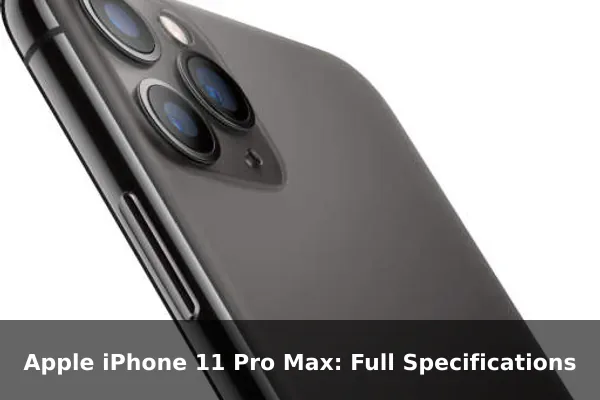
| Build: | Glass front (Corning-made glass), glass back (Corning-made glass), stainless steel frame |
| SIM: | Nano-SIM + eSIMNano-SIM + Nano-SIM (China) |
| IP68 dust tight and water resistant (immersible up to 4m for 30 min) Apple Pay (Visa, MasterCard, AMEX certified) |
Display
| Type: | Super Retina XDR OLED, HDR10, Dolby Vision, 800 nits (HBM), 1200 nits (peak) |
| Size: | 6.5 inches, 102.9 cm2 (~83.7% screen-to-body ratio) |
| Resolution: | 1242 x 2688 pixels, 19.5:9 ratio (~458 ppi density) |
| Protection: | Scratch-resistant glass |
Platform
| OS: | iOS 13, upgradable to iOS 18.6 |
| Chipset: | Apple A13 Bionic (7 nm+) |
| CPU: | Hexa-core (2×2.65 GHz Lightning + 4×1.8 GHz Thunder) |
| GPU: | Apple GPU (4-core graphics) |
Memory
| Card slot: | No |
| Internal: | 64GB 4GB RAM, 256GB 4GB RAM, 512GB 4GB RAM |
| NVMe |
Main Camera
| Triple: | 12 MP, f/1.8, 26mm (wide), 1/2.55″, 1.4µm, dual pixel PDAF, OIS 12 MP, f/2.0, 52mm (telephoto), 1/3.4″, 1.0µm, PDAF, OIS, 2x optical zoom 12 MP, f/2.4, 120˚, 13mm (ultrawide), 1/3.6″ |
| Features: | Dual-LED dual-tone flash, HDR (photo/panorama) |
| Video: | 4K@24/25/30/60fps, 1080p@25/30/60/120/240fps, HDR, stereo sound rec. |
Selfie camera
| Single: | 12 MP, f/2.2, 23mm (wide), 1/3.6″, 1.0µm SL 3D, (depth/biometrics sensor) |
| Features: | HDR |
| Video: | 4K@24/25/30/60fps, 1080p@25/30/60/120fps, gyro-EIS |
Sound
| Loudspeaker: | Yes, with stereo speakers |
| 3.5mm jack: | No |
Comms
| WLAN: | Wi-Fi 802.11 a/b/g/n/ac/6, dual-band, hotspot |
| Bluetooth: | 5.0, A2DP, LE |
| Positioning: | GPS, GLONASS, GALILEO, QZSS |
| NFC: | Yes |
| Radio: | No |
| USB: | Lightning, USB 2.0 |
Features
| Sensors: | Face ID, accelerometer, gyro, proximity, compass, barometer |
| Ultra Wideband (UWB) support |
Battery
| Type: | Li-Ion 3969 mAh, non-removable (15.04 Wh) |
| Charging: | Wired, PD2.0, 50% in 30 min Wireless (Qi) |
Misc
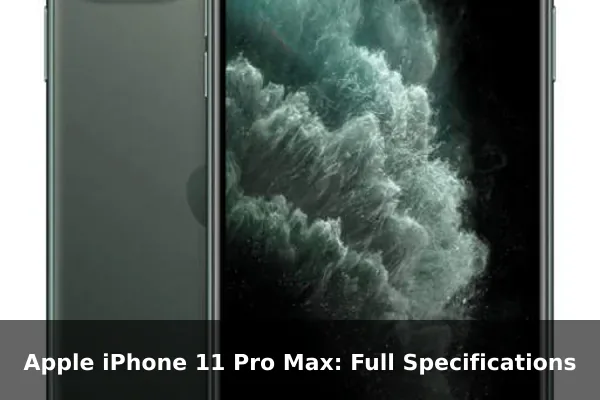
| Colors: | Matte Space Gray, Matte Silver, Matte Gold, Matte Midnight Green |
| Models: | A2218, A2161, A2220, iPhone12,5 |
| SAR: | 1.16 W/kg (head) 1.17 W/kg (body) |
| SAR EU: | 0.95 W/kg (head) 0.99 W/kg (body) |
| Price: | € 276.98 / $ 277.69 / £ 195.00 |
Our Tests
| Performance: | AnTuTu: 459713 (v7), 536883 (v8) GeekBench: 13870 (v4.4), 3503 (v5.1) GFXBench: 57fps (ES 3.1 onscreen) |
| Display: | 820 nits max brightness (measured) |
| Camera: | Photo / Video |
| Loudspeaker: | -25.6 LUFS (Very good) |
| Audio quality: | Noise -94.3dB / Crosstalk -81.5dB |
| Battery (old): | Endurance rating 102h |
Price and Availability
The Apple iPhone 11 Pro Max offers a compelling combination of features and performance. While the base price is around €277, the actual cost may vary depending on your location and retailer. Below, you’ll find the approximate price of the Apple iPhone 11 Pro Max converted into various currencies. Please note that these are estimates based on recent exchange rates as of August 11, 2026 and may not reflect the exact price you’ll find at a retailer.
- United States: $320
- Japan: ¥50,854
- United Kingdom: £237
- Australia: A$453
- Canada: C$446
- Taiwan: NT$10,314
- Denmark: kr2.067
- Saudi Arabia: ﷼1,199
- South Korea: ₩453,371
- Germany: €277
- Brazil: R$1.629
- Vietnam: ₫8.320.355
- Kenya: KSh 41,529
- India: ₹30,489
- Indonesia: Rp 5.669.540
- Nigeria: ₦435,837
- Pakistan: ₨88,776
- Philippines: ₱19,430
- Bangladesh: ৳৩৯,৫৩০
Why Should You Buy the Apple iPhone 11 Pro Max?
The strongest reason to consider the Apple iPhone 11 Pro Max is balance. It was built as Apple’s top large-screen iPhone for 2019, so it still carries many flagship traits: a stainless steel frame, a high-quality OLED display, Face ID, water resistance, wireless charging, stereo speakers, and three useful rear cameras. For buyers comparing older premium phones, that combination can feel more complete than many mid-range phones that focus on only one or two headline features.
Its current appeal depends heavily on condition, battery health, storage capacity, and price. The listed source price places it in a lower-cost flagship category, but real market value can vary by region, carrier lock status, refurbishment quality, and included warranty. The 64GB version is the least flexible choice today, while 256GB and 512GB variants are much easier to recommend for photos, video, offline media, and long-term app use.
Design and Build Quality
The iPhone 11 Pro Max has a substantial feel, with dimensions of 158 x 77.8 x 8.1 mm and a weight of 226 g. That makes it a large and heavy phone, especially compared with smaller iPhones and many modern mid-range Android models. The weight is part of the experience: the stainless steel frame and glass front and back give it a dense, premium feel, but one-handed use is not its strongest point.
The phone is rated IP68 for dust and water resistance, with immersion resistance listed up to 4 meters for 30 minutes. That rating is useful for accidental exposure, but it should not be treated as permanent protection on a used device because seals can age or be affected by repairs. Apple Pay support is also part of the body and security package, backed by Face ID and NFC.
Display Experience
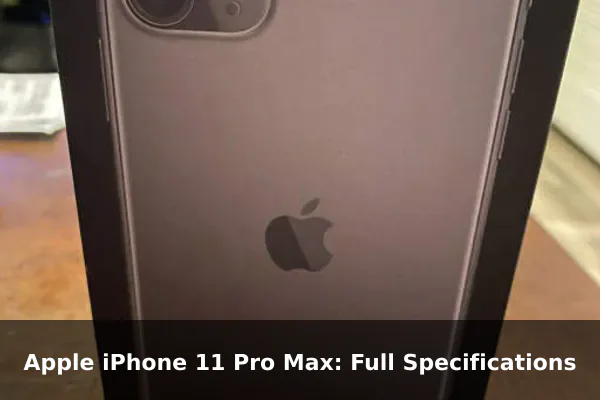
The 6.5-inch Super Retina XDR OLED display is one of the most important reasons this model still feels premium. It supports HDR10 and Dolby Vision, with a 1242 x 2688 resolution and about 458 ppi density. Text, photos, and video look sharp, while OLED contrast gives movies and dark-mode interfaces the deep blacks expected from a high-end iPhone.
Brightness is another strength. The source data lists 800 nits high-brightness mode and 1200 nits peak brightness, while the test figure notes 820 nits measured maximum brightness. That makes the display practical outdoors and particularly good for HDR playback. The main limitation is refresh rate: this generation does not offer a high-refresh display, so scrolling will not feel as fluid as on newer Pro iPhones with ProMotion.
Performance and Storage
The Apple A13 Bionic chip remains capable for everyday tasks, camera processing, gaming, and multitasking. Its hexa-core CPU uses two Lightning performance cores and four Thunder efficiency cores, paired with a 4-core Apple GPU. Benchmarks in the source data, including AnTuTu and GeekBench results, show why the phone was a major flagship performer at launch and why it still handles most normal workloads confidently.
Memory and storage are more important buying details. All listed configurations use 4GB of RAM with NVMe storage, and capacities are 64GB, 256GB, and 512GB. There is no card slot, so the storage choice is final. A 64GB unit can work for light users who stream media and rely on cloud storage, but anyone shooting 4K video should look for 256GB or higher.
Triple Camera System
The rear camera setup is versatile rather than experimental. It includes a 12MP wide camera with optical image stabilization, a 12MP telephoto camera with OIS and 2x optical zoom, and a 12MP ultrawide camera with a 120-degree field of view. This gives the iPhone 11 Pro Max a practical camera range for everyday photography: standard scenes, portraits, closer framing, landscapes, buildings, and group shots.
Video remains a major strength. The phone records 4K video at up to 60fps and 1080p video at high frame rates, with HDR and stereo sound recording listed in the source data. The front camera is also strong for its age, offering a 12MP sensor, 4K recording up to 60fps, 1080p slow-motion options, HDR, and gyro-EIS. Buyers who care about consistent video quality may find this model more dependable than many newer budget phones with higher-resolution but less refined sensors.
Battery and Charging
The iPhone 11 Pro Max has a 3969 mAh battery rated at 15.04 Wh, and the source testing lists an old endurance rating of 102 hours. That was excellent for its generation and remains one of the reasons this model is remembered as a strong battery iPhone. Real endurance today will depend heavily on battery health, iOS version, background apps, signal quality, and whether the device has had a battery replacement.
Charging support includes wired Power Delivery 2.0, with 50 percent in 30 minutes listed, and Qi wireless charging. The Lightning port is limited to USB 2.0 speeds, so large wired transfers are not as convenient as on USB-C phones. For most users, the practical charging experience is still acceptable, but buyers coming from newer fast-charging Android phones should expect slower top-ups.
Software and Long-Term Use
The phone launched with iOS 13 and is listed as upgradable to iOS 18.6. That software support is a major advantage over many Android phones from the same era. It keeps the device relevant for modern apps, security updates, Apple services, and ecosystem features such as iCloud, AirDrop, FaceTime, iMessage, Apple Pay, and Apple Watch pairing.
The tradeoff is that future support is not unlimited. As an older device, it may eventually lose access to later iOS versions before newer iPhones do. Buyers should also consider battery replacement availability and the condition of used units. A well-kept iPhone 11 Pro Max can still feel modern in daily use, but a heavily worn unit with degraded battery health may not deliver the same experience.
Connectivity and Network Coverage
The iPhone 11 Pro Max is a 4G LTE phone, not a 5G phone. Its network support includes GSM, CDMA, HSPA, EVDO, and LTE, with broad LTE band coverage across model variants A2218, A2161, and A2220. That makes model selection important, especially for buyers importing a unit or switching carriers. The listed LTE speed reaches up to 1.6 Gbps downlink under supported network conditions.
Wireless connectivity is strong for its generation, with Wi-Fi 6, Bluetooth 5.0, GPS, GLONASS, GALILEO, QZSS, NFC, and Ultra Wideband support. There is no FM radio and no 3.5mm headphone jack. Dual SIM support depends on market configuration, with Nano-SIM plus eSIM for many regions and dual Nano-SIM for China models.
Who Should Choose This iPhone?
The iPhone 11 Pro Max is best for buyers who want a large premium iPhone at a lower price than newer Pro Max models and do not need 5G, USB-C, MagSafe, or a 120Hz display. It is especially appealing for users who prioritize OLED quality, reliable cameras, strong video recording, long battery potential, and iOS ecosystem features.
It is less ideal for buyers who want a compact phone, the latest Apple camera processing, satellite safety features, high-refresh display smoothness, or the longest possible future software runway. For used-device shoppers, the best version is a clean, unlocked 256GB or 512GB unit with strong battery health and no display, Face ID, or water-damage issues.
Conclusion
The Apple iPhone 11 Pro Max is no longer the newest flagship, but its OLED display, A13 Bionic performance, triple 12MP cameras, stereo speakers, IP68 build, and strong battery reputation still make it a serious used-iPhone option. Choose it if the price is right, the battery is healthy, and 4G LTE is enough for your needs.
References
- Apple Support – iPhone 11 Pro Max Technical Specifications – Primary Apple specification sheet for dimensions, display, chip, cameras, wireless bands, battery claims, sensors, SIM support, and original operating system.
- Apple Support – Identify your iPhone model – Official Apple reference for confirming iPhone 11 Pro Max model numbers, launch year, capacities, colors, and physical identifying details.
- Apple Newsroom – iPhone 11 Pro and iPhone 11 Pro Max announcement – Official launch announcement for release timing, positioning, headline features, colors, and availability context.
- Apple Regulatory Information – iPhone RF Exposure Information – Official Apple regulatory page for RF exposure and SAR details tied to iPhone12,5 and related model numbers.
- PhoneArena – Apple iPhone 11 Pro Max Full Specifications – Established phone specifications database useful for cross-checking supplemental fields Apple may not list directly, such as RAM, battery capacity, FCC ID, and measured SAR.
