
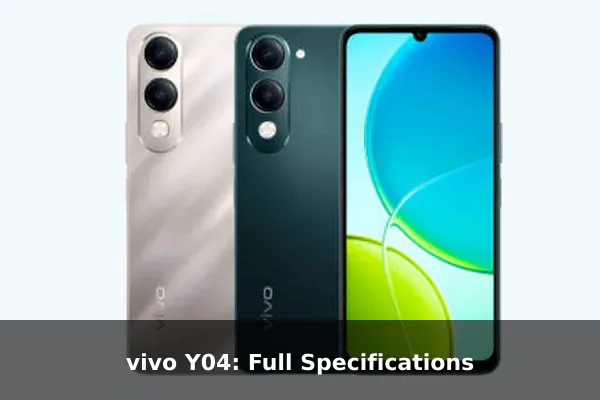
The vivo Y04 is a budget-friendly entry in vivo’s long-running Y series, announced on February 26, 2025 and released on March 11, 2025. Pitched at roughly 110 EUR, it aims to deliver everyday essentials such as a large 6.74-inch display, a 5,500 mAh battery, and IP64 with MIL-STD-810H compliance, packaging them inside a familiar plastic-and-glass shell that weighs 199 g.
Positioned beneath flashier mid-range siblings, the Y04 leans on a Unisoc T7225 chipset, Android 14 with Funtouch 14, and a single 13 MP main camera. This article unpacks what those choices mean in daily use, where the phone earns its asking price, and where shoppers should temper expectations.
Full Specifications
Network
| Technology: | GSM / HSPA / LTE |
| 2G bands: | GSM 850 / 900 / 1800 / 1900 |
| 3G bands: | HSDPA 850 / 900 / 2100 |
| 4G bands: | 1, 3, 5, 7, 8, 20, 28, 38, 40, 41 – International |
| 1, 3, 5, 8, 38, 40, 41 – India | |
| Speed: | HSPA, LTE |
Launch
| Announced: | 2025, February 26 |
| Status: | Available. Released 2025, March 11 |
Body
| Dimensions: | 167.3 x 77 x 8.2 mm (6.59 x 3.03 x 0.32 in) |
| Weight: | 199 g (7.02 oz) |
| Build: | Glass front, plastic frame, plastic back |
| SIM: | Nano-SIM + Nano-SIM |
| IP64 dust tight and water resistant (water splashes) MIL-STD-810H compliant* * does not guarantee ruggedness or use in extreme conditions |
Display
| Type: | IPS LCD, 90Hz, 570 nits (HBM) |
| Size: | 6.74 inches, 109.7 cm2 (~85.1% screen-to-body ratio) |
| Resolution: | 720 x 1600 pixels, 20:9 ratio (~260 ppi density) |
| Protection: | Mohs level 5 |
Platform
| OS: | Android 14, Funtouch 14 |
| Chipset: | Unisoc T7225 (12 nm) |
| CPU: | Octa-core (2×2.0 GHz Cortex-A75 & 6×1.8 GHz Cortex-A55) |
| GPU: | Mali-G52 MP1 |
Memory
| Card slot: | microSDXC (dedicated slot) |
| Internal: | 64GB 4GB RAM, 128GB 4GB RAM, 128GB 6GB RAM, 256GB 4GB RAM |
| eMMC 5.1 |
Main Camera
| Single: | 13 MP, f/2.2, (wide), PDAF 0.08 MP, f/3.0 (auxiliary lens) |
| Features: | LED flash, panorama |
| Video: | 1080p@30fps |
Selfie camera
| Single: | 5 MP, f/2.2, (wide) |
| Video: | Yes |
Sound
| Loudspeaker: | Yes, with stereo speakers |
| 3.5mm jack: | Yes |
Comms
| WLAN: | Wi-Fi 802.11 a/b/g/n/ac, dual-band |
| Bluetooth: | 5.2, A2DP, LE |
| Positioning: | GPS, GALILEO, GLONASS, BDS, QZSS |
| NFC: | No |
| Radio: | FM radio |
| USB: | USB Type-C 2.0, OTG |
Features
| Sensors: | Fingerprint (side-mounted), accelerometer, proximity, compass |
Battery
| Type: | Li-Ion 5500 mAh |
| Charging: | 15W wired |
Misc
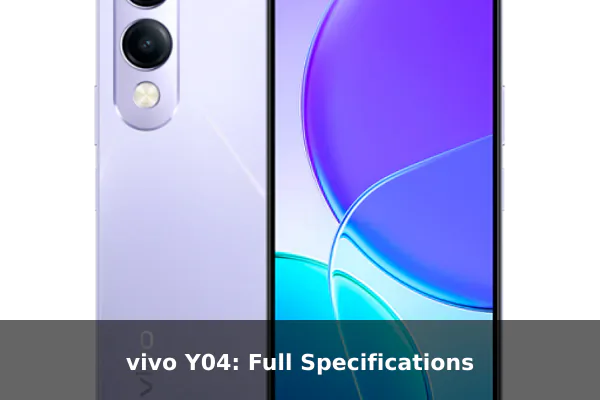
| Colors: | Titanium Gold (Titanium Silver), Dark Green (Majestic Green), Violet |
| Models: | V2430 |
| SAR: | 0.97 W/kg (head) 0.93 W/kg (body) |
| Price: | About 110 EUR |
EU LABEL
| Energy: | Class A |
| Battery: | 52:40h endurance, 1000 cycles |
| Free fall: | Class A (300 falls) |
| Repairability: | Class B |
Price and Availability
The vivo Y04 offers a compelling combination of features and performance. While the base price is around €110, the actual cost may vary depending on your location and retailer. Below, you’ll find the approximate price of the vivo Y04 converted into various currencies. Please note that these are estimates based on recent exchange rates as of June 7, 2026 and may not reflect the exact price you’ll find at a retailer.
- United States: $127
- Japan: ¥20,376
- United Kingdom: £95
- Australia: A$180
- Canada: C$177
- Taiwan: NT$4,011
- Denmark: kr821
- Saudi Arabia: ﷼477
- South Korea: ₩197,101
- Germany: €110
- Brazil: R$649
- Vietnam: ₫3.340.258
- Kenya: KSh 16,504
- India: ₹12,148
- Indonesia: Rp 2.305.644
- Nigeria: ₦171,784
- Pakistan: ₨35,407
- Philippines: ₱7,849
- Bangladesh: ৳১৫,৬০৩
Value at the Entry Level
According to the source data, the vivo Y04 launches at about 110 EUR, putting it firmly in the budget tier alongside other recent entry-level vivo, Samsung Galaxy A0x, and Redmi 14C devices. For that price, buyers get a large display, a sizable battery, side-mounted fingerprint reader, and a dedicated microSDXC slot, which is increasingly rare even in this segment. Cross-checking with vivo’s official regional sites such as vivo.com/eu, vivo.com/ph, and shop.vivo.com is recommended because configurations, colors, and pricing can vary noticeably by market.
Design, Build, and Durability
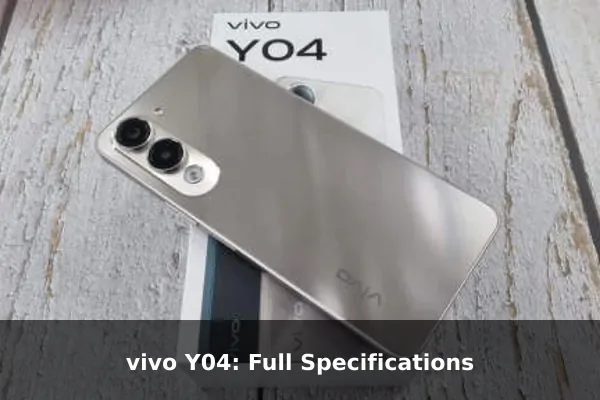
The Y04 measures 167.3 x 77 x 8.2 mm and weighs 199 g, with a glass front, plastic frame, and plastic back. Three colorways are listed, Titanium Gold (Titanium Silver), Dark Green (Majestic Green), and Violet, giving buyers a relatively understated palette. The headline durability claim is IP64 dust-tight and splash-resistant certification, plus MIL-STD-810H compliance. As vivo itself notes in similar listings, that compliance does not guarantee ruggedness or use in extreme conditions, so the rating should be read as added insurance against everyday accidents rather than a license to submerge the phone.
Display and Daily Viewing
vivo equips the Y04 with a 6.74-inch IPS LCD panel running at 720 x 1600 pixels, a 20:9 ratio, and roughly 260 ppi. A 90 Hz refresh rate keeps scrolling smoother than the typical 60 Hz budget panel, and peak brightness is quoted at 570 nits in HBM mode. The screen-to-body ratio sits around 85.1%, with Mohs level 5 surface hardness offering modest scratch resistance. For social feeds, messaging, and casual video the panel is serviceable, but those who prioritize sharp text or bright outdoor visibility will likely outgrow it quickly.
Performance and Software
The Unisoc T7225 on a 12 nm process pairs two Cortex-A75 cores at 2.0 GHz with six Cortex-A55 cores at 1.8 GHz, plus a single-core Mali-G52 MP1 GPU. RAM and storage tiers include 64 GB / 4 GB, 128 GB / 4 GB, 128 GB / 6 GB, and 256 GB / 4 GB, with eMMC 5.1 storage rather than faster UFS. The combination is tuned for light multitasking, web browsing, and casual gaming at lower settings, not heavy 3D titles. Android 14 with Funtouch 14 ships out of the box, and shoppers should check vivo’s regional pages for committed update timelines, which tend to be modest at this price.
Cameras and Imaging
The rear camera array is intentionally simple, with a 13 MP f/2.2 main sensor that includes PDAF and a 0.08 MP f/3.0 auxiliary lens for depth assistance. Features list LED flash, panorama, and 1080p video at 30 fps. The front camera is a 5 MP f/2.2 unit with video capture support. Expectations should match the segment: usable daylight shots, softer low-light performance, and limited dynamic range compared with more expensive Y-series or A-series rivals. Buyers focused on imaging may want to consider stepping up the lineup, while casual social media users will likely find the Y04 sufficient.
Battery and Charging
The 5,500 mAh Li-Ion cell is one of the clearest strengths of the Y04 and supports 15 W wired charging. The provided EU energy label data lists 52:40h endurance and a 1,000-cycle battery rating with an overall Class A energy rating, suggesting strong longevity per charge and reasonable long-term battery health. Charging speeds are modest, so a full top-up will take noticeably longer than competitors offering 33 W or 45 W, but the trade-off favors users who prioritize multi-day standby over rapid refills.
Connectivity and Extras
Connectivity covers GSM, HSPA, and LTE only, with no 5G support; LTE bands differ by region, listing the International set (1, 3, 5, 7, 8, 20, 28, 38, 40, 41) and a narrower India set (1, 3, 5, 8, 38, 40, 41). Dual-band Wi-Fi 802.11 a/b/g/n/ac, Bluetooth 5.2, GPS with GALILEO, GLONASS, BDS, and QZSS, an FM radio, USB Type-C 2.0 with OTG, and a 3.5 mm jack round out the package. Stereo speakers are included, while NFC is not, which may matter for buyers planning to use contactless payments. The side-mounted fingerprint sensor is joined by an accelerometer, proximity sensor, and compass.
Who Should Buy the vivo Y04
The vivo Y04 makes the most sense for buyers who want a dependable backup device, a first smartphone for a younger user, or a simple daily driver focused on calls, messaging, and light app use. Its combination of a large battery, expandable storage, IP64 rating, and an approachable price aligns with those priorities. Heavy gamers, mobile photographers, and users who depend on 5G or NFC payments will be better served by stepping up to a higher tier in vivo’s lineup or considering rivals at slightly higher price points.
Conclusion
Within the boundaries of an entry-level budget, the vivo Y04 delivers where it counts: a large 90 Hz display, a 5,500 mAh battery rated for 1,000 cycles, a clean set of extras including a headphone jack and microSDXC, and modest splash and drop protection. Compromises around the Unisoc T7225, eMMC storage, 720p resolution, and 4G-only connectivity are predictable at this price. If your priorities are battery life and reliability over performance and imaging, the Y04 is a sensible pick; otherwise, save a little more for a step-up Y-series or comparable rival, and always confirm market-specific specs and pricing on vivo’s official regional pages before purchasing.
Official references
- vivo Europe Y04 Specifications – Official English vivo specifications page for Y04, including platform, storage, battery, display, camera, network bands, sensors, box contents, and regional notes.
- vivo Philippines Y04 Specifications – Official vivo market page useful for cross-checking Y04 specifications and availability in an English-language Asia-Pacific market.
- vivo South Africa Y04 Specifications – Official English vivo specifications page that can help verify market-specific Y04 variants, battery claims, colors, and packaging details.
- vivo Indonesia Official Store Y04 – Official vivo Indonesia store listing for checking local Y04 configuration, colors, availability, and current official pricing.
- FCC Equipment Authorization – Official U.S. regulator database for confirming device certification details by FCC ID; useful for radio/SAR filings when searching model V2430 or FCC ID 2AUCY-V2430.
