
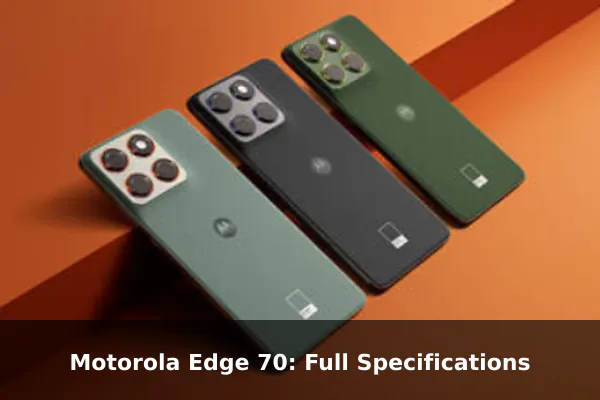
The Motorola Edge 70 is a slim Android smartphone built around a 6 mm aluminum-frame design, a 6.7-inch P-OLED display, and Qualcomm’s Snapdragon 7 Gen 4 platform. It sits in the upper mid-range space, but several details, including IP68/IP69 protection, 50 MP front and rear cameras, and wireless charging, push it closer to premium territory.
This specifications-focused overview looks beyond the raw table and explains how the Motorola Edge 70 fits for buyers who care about design, screen quality, everyday performance, camera flexibility, battery endurance, software, and connectivity. A separate full specifications table and price block can be used for exact line-by-line data and market pricing.
Full Specifications
Network
| Technology: | GSM / CDMA / HSPA / LTE / 5G |
| 2G bands: | GSM 850 / 900 / 1800 / 1900 |
| CDMA 800 | |
| 3G bands: | HSDPA 850 / 900 / 1700(AWS) / 1900 / 2100 |
| 4G bands: | 1, 2, 3, 4, 5, 7, 8, 12, 13, 17, 18, 19, 20, 25, 26, 28, 32, 34, 38, 39, 40, 41, 42, 43, 48, 66 |
| 5G bands: | 1, 2, 3, 5, 7, 8, 20, 26, 28, 38, 40, 41, 66, 75, 77, 78 SA/NSA/Sub6 |
| Speed: | HSPA, LTE, 5G |
Launch
| Announced: | 2025, October 29 |
| Status: | Available. Released 2025, October 29 |
Body
| Dimensions: | 159.9 x 74 x 6 mm (6.30 x 2.91 x 0.24 in) |
| Weight: | 159 g (5.61 oz) |
| Build: | Glass front (Gorilla Glass 7i), aluminum frame |
| SIM: | · Nano-SIM + eSIM – International· Nano-SIM + Nano-SIM – China |
| IP68/IP69 dust tight and water resistant (high pressure water jets; immersible up to 1.5m for 30 min) MIL-STD-810H compliant* * does not guarantee ruggedness or use in extreme conditions |
Display
| Type: | P-OLED, 1B colors, 120Hz, PWM, HDR10+, 4500 nits (peak) |
| Size: | 6.7 inches, 107.4 cm2 (~90.8% screen-to-body ratio) |
| Resolution: | 1220 x 2712 pixels, 20:9 ratio (~446 ppi density) |
| Protection: | Corning Gorilla Glass 7i, Mohs level 4 |
Platform
| OS: | Android 16, up to 3 or 4 major Android upgrades (market/region dependent) |
| Chipset: | Qualcomm SM7750-AB Snapdragon 7 Gen 4 (4 nm) |
| CPU: | Octa-core (1×2.8 GHz Cortex-720 & 4×2.4 GHz Cortex-720 & 3×1.8 GHz Cortex-520) |
| GPU: | Adreno 722 |
Memory
| Card slot: | No |
| Internal: | 256GB 8GB RAM, 256GB 12GB RAM, 512GB 12GB RAM |
| UFS 3.1 |
Main Camera
| Dual: | 50 MP, f/1.8, 24mm (wide), 1/1.56″, 1.0µm, multi-directional PDAF, OIS 50 MP, f/2.0, 12mm, 120˚ (ultrawide), 1/2.76″, 0.64µm, PDAF |
| Features: | LED flash, HDR, panorama |
| Video: | 4K@30/60fps, 1080p@30/60/120/240fps, gyro-EIS |
Selfie camera
| Single: | 50 MP, f/2.0, 21mm (wide), 1/2.76″, 0.64µm |
| Features: | HDR |
| Video: | 4K@30fps, 1080p@30/120fps |
Sound
| Loudspeaker: | Yes, with stereo speakers (with Dolby Atmos) |
| 3.5mm jack: | No |
Comms
| WLAN: | Wi-Fi 802.11 a/b/g/n/ac/6e, dual-band or tri-band |
| Bluetooth: | 5.4, A2DP, LE |
| Positioning: | GPS, GALILEO, GLONASS, BDS, QZSS |
| NFC: | Yes |
| Radio: | No |
| USB: | USB Type-C 2.0, OTG |
Features
| Sensors: | Fingerprint (under display, optical), accelerometer, gyro, proximity, compass |
| Smart Connect support |
Battery
| Type: | Si/C Li-Ion 4800 mAh |
| Charging: | 68W wired 15W wireless |
Misc
| Colors: | Pantone: Gadget Gray, Lily Pad, Bronze Green |
| Models: | XT2601-2, XT2603-2 |
| Price: | € 768.31 / $ 1,040.00 / £ 695.00 / ₹ 30,999 |
Our Tests
| Performance: | AnTuTu: 1125461 (v10), 1390960 (v11) GeekBench: 4185 (v6) 3DMark: 2085 (Wild Life Extreme) |
| Loudspeaker: | -24.2 LUFS (Very good) |
| Battery: | Active use score 13:36h |
EU LABEL
| Energy: | Class A |
| Battery: | 50:14h endurance, 1000 cycles |
| Free fall: | Class A (270 falls) |
| Repairability: | Class B |
Price and Availability
The Motorola Edge 70 offers a compelling combination of features and performance. While the base price is around €768, the actual cost may vary depending on your location and retailer. Below, you’ll find the approximate price of the Motorola Edge 70 converted into various currencies. Please note that these are estimates based on recent exchange rates as of August 21, 2026 and may not reflect the exact price you’ll find at a retailer.
- United States: $898
- Japan: ¥142,570
- United Kingdom: £658
- Australia: A$1,261
- Canada: C$1,237
- Taiwan: NT$28,614
- Denmark: kr5.744
- Saudi Arabia: ﷼3,366
- South Korea: ₩1,252,364
- Germany: €768
- Brazil: R$4.659
- Vietnam: ₫23.277.083
- Kenya: KSh 116,238
- India: ₹85,909
- Indonesia: Rp 15.919.243
- Nigeria: ₦1,215,565
- Pakistan: ₨249,300
- Philippines: ₱55,340
- Bangladesh: ৳১,০৯,৬৯৪
Why the Motorola Edge 70 Stands Out
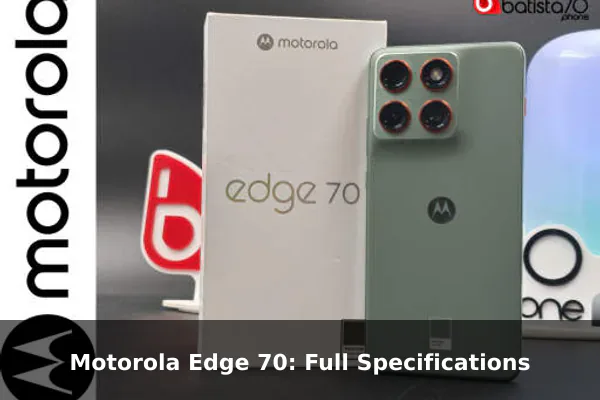
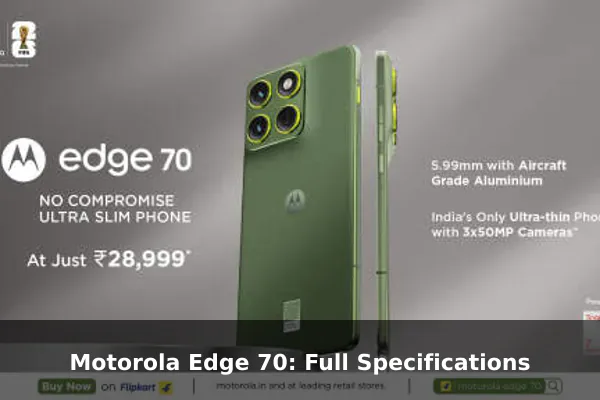
The main hook of the Motorola Edge 70 is its unusually thin body. At 6 mm and 159 g, it is clearly aimed at users who want a large-screen phone that does not feel bulky in the hand or pocket. That design direction makes it different from many performance-heavy Android phones that chase bigger batteries and thicker camera systems.
Motorola still gives it a strong hardware base. The Snapdragon 7 Gen 4 chipset, 120Hz P-OLED screen, dual 50 MP rear cameras, 50 MP selfie camera, 68W wired charging, and 15W wireless charging create a well-rounded package. It is not positioned as a gaming flagship, but it looks like a premium daily phone for people who value balance over maximum raw power.
Design and Durability
The Motorola Edge 70 uses a glass front with Gorilla Glass 7i and an aluminum frame, giving it a more refined build than many plastic mid-range models. Its 159.9 x 74 x 6 mm dimensions are the key design detail, because the phone keeps a 6.7-inch display while staying very thin. The 159 g weight should also make it easier to use one-handed than many large-screen rivals.
Durability is another important part of the story. The phone is listed with IP68/IP69 dust and water resistance, meaning it is designed to resist dust, immersion, and high-pressure water jets under specified conditions. It is also marked as MIL-STD-810H compliant, although that does not mean it should be treated as a rugged phone for extreme use. For everyday buyers, the value is added confidence against rain, splashes, and accidental exposure.
Display Experience
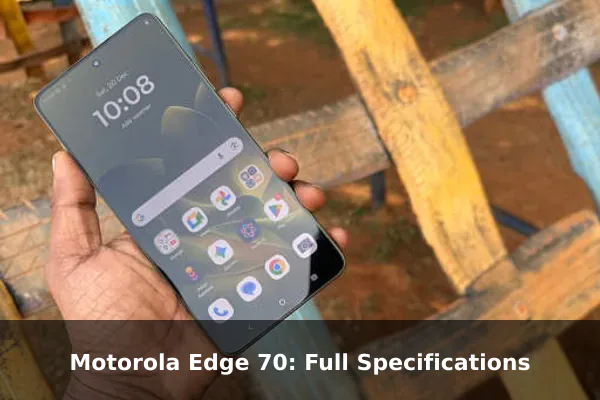
The 6.7-inch P-OLED panel gives the Motorola Edge 70 a modern display profile. It supports 1 billion colors, HDR10+, a 120Hz refresh rate, and a peak brightness rating of 4500 nits. The 1220 x 2712 resolution works out to about 446 ppi, so text, icons, and photos should appear sharp without needing a full QHD-class panel.
The display size and roughly 90.8 percent screen-to-body ratio make it suitable for video, maps, social apps, and reading. Motorola also lists PWM support, which may matter to users who are sensitive to screen flicker. Protection is handled by Corning Gorilla Glass 7i with a Mohs level 4 reference in the source data, so buyers should still consider a screen protector if scratch resistance is a priority.
Performance and Storage
The Snapdragon 7 Gen 4 is a 4 nm chipset with an octa-core CPU layout and Adreno 722 graphics. It is not Motorola’s absolute top-tier silicon, but it should be efficient and fast enough for multitasking, high-refresh scrolling, messaging, navigation, streaming, photo editing, and most popular games. The supplied benchmark figures are strong for this class, including AnTuTu results above one million in version 10 and version 11.
Memory options include 256GB with 8GB RAM, 256GB with 12GB RAM, and 512GB with 12GB RAM. Storage uses UFS 3.1, which helps app loading and file handling compared with slower storage standards. There is no memory card slot, so the 512GB variant is the safer choice for users who record a lot of 4K video, keep large offline media libraries, or avoid cloud storage.
Camera Setup
The rear camera system is simple but useful: a 50 MP wide camera with optical image stabilization and a 50 MP ultrawide camera with a 120-degree field of view. This is a practical two-camera setup, because it avoids low-value filler sensors and focuses on the two focal ranges most people use every day. The main camera has multi-directional PDAF and OIS, which should help with focus speed and handheld stability.
Video support is also competitive for the category, with 4K recording at 30 or 60 fps and 1080p recording up to 240 fps, plus gyro-EIS. The 50 MP front camera is stronger than the basic selfie cameras found on many mid-range phones, and it can record 4K at 30 fps. For vlog-style clips, video calls, and social content, that front camera specification is a meaningful advantage.
Battery Life and Charging
The Motorola Edge 70 uses a 4800 mAh silicon-carbon lithium-ion battery. That capacity is not the largest in the segment, but it is notable considering the phone’s 6 mm body. The supplied active use score of 13 hours and 36 minutes suggests the phone is built for a full day of mixed use rather than only for thinness.
Charging is a strong point. The phone supports 68W wired charging and 15W wireless charging, giving users both speed and convenience. The EU label data also lists Class A energy rating, 50 hours and 14 minutes of endurance, 1000 battery cycles, Class A free-fall rating, and Class B repairability. Those labels add useful context for buyers comparing long-term ownership, not just launch-day specifications.
Software and Features
The Motorola Edge 70 ships with Android 16. The source data notes up to three or four major Android upgrades depending on market or region, so buyers should check the exact policy for their country before purchase. That regional note matters, because software longevity can affect resale value and long-term security.
Feature-wise, the phone includes an under-display optical fingerprint sensor, accelerometer, gyroscope, proximity sensor, compass, and Smart Connect support. Smart Connect is useful for users already in Motorola’s ecosystem or those who want easier cross-device workflows with compatible displays and computers. Stereo speakers with Dolby Atmos support are included, but there is no 3.5 mm headphone jack.
Connectivity and Network Coverage
Network support is broad, covering GSM, CDMA, HSPA, LTE, and sub-6 5G. The listed 4G and 5G band support is extensive, which is helpful for users who travel or buy unlocked phones. As always, exact carrier compatibility should be checked before importing a model, especially because SIM support differs by market.
The international version is listed with Nano-SIM plus eSIM, while the China version is listed with dual Nano-SIM. Wireless features include Wi-Fi 6e, Bluetooth 5.4, NFC, multi-system satellite positioning, and USB Type-C with OTG. The USB standard is Type-C 2.0, so users who frequently transfer large local video files should note that it is not a high-speed USB implementation.
Who Should Buy It
The Motorola Edge 70 makes the most sense for buyers who want a thin, light Android phone without giving up a large display, strong cameras, fast charging, water resistance, and current software. It is especially appealing if comfort, design, and everyday practicality matter more than having the most powerful flagship chipset.
It is less ideal for users who need expandable storage, a headphone jack, the fastest USB data transfer, or a dedicated telephoto camera. Mobile gamers who prioritize sustained high-end graphics may also prefer a thicker phone with a flagship chipset and larger thermal headroom. For most mainstream users, however, the Edge 70 offers a polished mix of design, features, and durability.
Conclusion
The Motorola Edge 70 is a distinctive upper mid-range phone because it combines a very slim 6 mm body with a bright 120Hz P-OLED display, Snapdragon 7 Gen 4 performance, dual 50 MP rear cameras, a 50 MP selfie camera, IP68/IP69 protection, and both wired and wireless charging. It is best for buyers who want a premium-feeling Android phone that stays light and practical. Recommended for users who value design, display quality, and everyday balance over maximum flagship power.
References
- Motorola Support – Specifications: motorola edge 70 – Official Motorola support specification sheet for core hardware details, connectivity bands, cameras, display, battery, charging, dimensions, and market-variation notes.
- Motorola Official Product Page – motorola edge 70 – Official Motorola product page useful for verifying marketed features, design, display, cameras, chipset, software-support claims, durability ratings, and official imagery.
- Motorola News – motorola edge 70 announcement – Official Motorola newsroom launch article with announced pricing, availability, and headline specifications for cross-checking release context.
- Notebookcheck – Motorola Edge 70 specs and review collection – Established hardware publication with detailed independent specs, measurements, review links, and cross-checks for display, chipset, battery, connectivity, dimensions, and weight.
- PhoneArena – Motorola Edge 70 full specifications – Long-running phone database and review site useful as a secondary reference for release date, variants, specs, benchmark context, and battery or display test data.
