
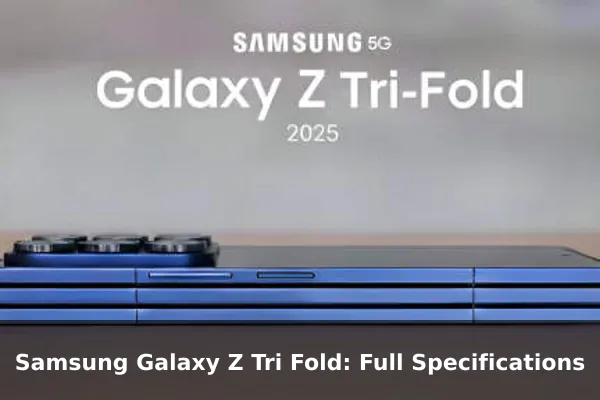
The Samsung Galaxy Z Tri Fold pushes the foldable format into new territory, using two hinges to fold a large 10.0-inch interior canvas down to a pocketable slab. Announced on December 2, 2025 and released ten days later, it arrives as one of Samsung’s most ambitious form factors yet, pairing a tri-foldable Dynamic LTPO AMOLED 2X panel with a Snapdragon 8 Elite platform and a 200 MP main camera. Reported pricing lands around 2100 EUR (converted from the S. Korea price), placing it firmly in the ultra-premium tier.
This overview looks past the raw numbers to explain what the tri-fold design actually delivers day to day, where the engineering trade-offs sit, and which type of buyer will get the most from it. Wherever specifications are cited, they follow the source data; pricing and availability can shift by region, so treat those figures as indicative rather than final.
Full Specifications
Network
| Technology: | GSM / CDMA / HSPA / EVDO / LTE / 5G |
| 2G bands: | GSM 850 / 900 / 1800 / 1900 |
| CDMA 800 / 1900 | |
| 3G bands: | HSDPA 850 / 900 / 1700(AWS) / 1900 / 2100 |
| CDMA2000 1xEV-DO | |
| 4G bands: | LTE |
| 5G bands: | SA/NSA/Sub6 |
| Speed: | HSPA, LTE, 5G |
Launch
| Announced: | 2025, December 02 |
| Status: | Available. Released 2025, December 12 |
Body
| Dimensions: | Unfolded: 159.2 x 214.1 x 3.9-4.2 mmFolded: 159.2 x 75 x 12.9 mm |
| Weight: | 309 g (10.90 oz) |
| Build: | Glass front (Gorilla Glass Victus Ceramic 2) (folded), plastic front (unfolded), ceramic-glass fiber-reinforced polymer back, aluminum frame, titanium hinge housing |
| SIM: | · Nano-SIM + Nano-SIM + eSIM + eSIM (max 2 at a time)· Nano-SIM + Nano-SIM + multiple eSIM (max 2 at a time)· Nano-SIM + Nano-SIM |
| IP48 dust and water resistant (dust > 1mm; immersible up to 1.5m for 30 min) Advanced Armor aluminum frame |
Display
| Type: | Tri-foldable Dynamic LTPO AMOLED 2X, 120Hz, HDR, 1600 nits (peak) |
| Size: | 10.0 inches, 305.4 cm2 (~89.6% screen-to-body ratio) |
| Resolution: | 1584 x 2160 pixels, 4:3 ratio (~269 ppi density) |
| Dynamic LTPO AMOLED 2X, 120Hz, HDR, 2600 nits (peak), Corning Gorilla Glass Ceramic 2 6.5 inches, 1080 x 2520 pixels, 422 ppi |
Platform
| OS: | Android 16, One UI 8 |
| Chipset: | Qualcomm SM8750-AC Snapdragon 8 Elite (3 nm) |
| CPU: | Octa-core (2×4.47 GHz Oryon V2 Phoenix L + 6×3.53 GHz Oryon V2 Phoenix M) |
| GPU: | Adreno 830 (1200 MHz) |
Memory
| Card slot: | No |
| Internal: | 512GB 16GB RAM, 1TB 16GB RAM |
| UFS |
Main Camera
| Triple: | 200 MP, f/1.7, 24mm (wide), 1/1.3″, 0.6µm, multi-directional PDAF, OIS 10 MP, f/2.4, 67mm (telephoto), 1/3.94″, 1.0µm, PDAF, OIS, 3x optical zoom 12 MP, f/2.2, 13mm, 120˚ (ultrawide), 1/2.55″, 1.4µm, dual pixel PDAF |
| Features: | LED flash, HDR, panorama |
| Video: | 8K@30fps, 4K@60fps, 1080p@60/120/240fps (gyro-EIS), 10-bit HDR, HDR10+ |
Selfie camera
| Single: | 10 MP, f/2.2, 18mm (ultrawide), 1/3.0″, 1.12µm Cover camera: 10 MP, f/2.2, 24mm (wide), 1/3.0″, 1.12µm |
| Features: | HDR |
| Video: | 4K@30/60fps, 1080p@30/60fps, gyro-EIS |
Sound
| Loudspeaker: | Yes, with stereo speakers |
| 3.5mm jack: | No |
Comms
| WLAN: | Wi-Fi 802.11 a/b/g/n/ac/6e/7, tri-band, Wi-Fi Direct |
| Bluetooth: | 5.4, A2DP, LE, aptX HD |
| Positioning: | GPS, GALILEO, GLONASS, BDS, QZSS |
| NFC: | Yes |
| Radio: | No |
| USB: | USB Type-C |
Features
| Sensors: | Fingerprint (side-mounted), accelerometer, gyro, proximity, compass, barometer |
| Samsung DeX wireless (desktop experience support) |
Battery
| Type: | Li-Ion 5600 mAh |
| Charging: | 45W wired, QC2.0, 50% in 30 min 15W wireless 4.5W reverse wireless |
Misc
| Colors: | Crafted Black |
| Models: | SM-D639B, SM-D639B/DS, SM-D639U, SM-D639U1, SM-D639N, SM-D6390 |
| Price: | About 2100 EUR (price in S. Korea) |
Price and Availability
The Samsung Galaxy Z Tri Fold offers a compelling combination of features and performance. While the base price is around €2.100, the actual cost may vary depending on your location and retailer. Below, you’ll find the approximate price of the Samsung Galaxy Z Tri Fold converted into various currencies. Please note that these are estimates based on recent exchange rates as of September 24, 2026 and may not reflect the exact price you’ll find at a retailer.
- United States: $2,394
- Japan: ¥378,445
- United Kingdom: £1,805
- Australia: A$3,396
- Canada: C$3,372
- Taiwan: NT$75,982
- Denmark: kr15.700
- Saudi Arabia: ﷼8,976
- South Korea: ₩3,268,619
- Germany: €2.100
- Brazil: R$12.293
- Vietnam: ₫62.168.093
- Kenya: KSh 310,352
- India: ₹2,29,139
- Indonesia: Rp 42.638.309
- Nigeria: ₦3,234,495
- Pakistan: ₨663,180
- Philippines: ₱149,872
- Bangladesh: ৳২,৯৪,০৭৯
Who Should Buy the Galaxy Z Tri Fold
This is a device for a specific enthusiast: someone who wants tablet-class screen real estate that still slips into a jacket pocket, and who is comfortable paying a flagship-plus premium of roughly 2100 EUR to get there. Multitaskers, mobile creatives, and readers who value a large canvas will benefit most from the dual-hinge design and Samsung DeX wireless support. Buyers who mainly want a conventional slab phone, or who prioritize the lowest price, are better served elsewhere in the Galaxy range.
Design and Build Quality
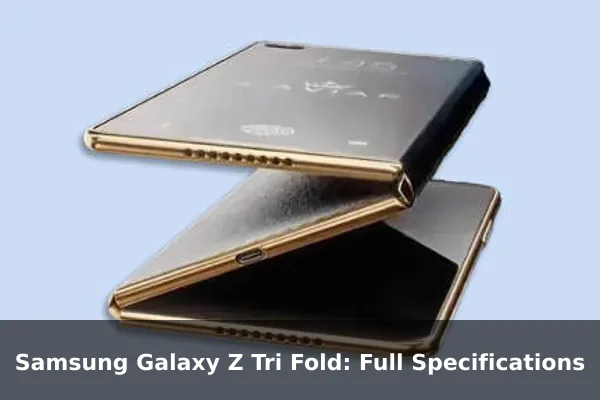
The tri-fold mechanism is the headline. Unfolded, the body measures 159.2 x 214.1 x 3.9-4.2 mm; folded, it thickens to 12.9 mm at 159.2 x 75 mm, and it weighs 309 g. Samsung leans on premium materials to manage that bulk: a Gorilla Glass Victus Ceramic 2 cover, a ceramic glass-fiber-reinforced polymer back, an Advanced Armor aluminum frame, and a titanium hinge housing. IP48 dust and water resistance adds real reassurance for a folding device, with immersion rated up to 1.5 m for 30 minutes, though the sub-1 mm particle caveat reflects the challenge of sealing multiple hinges.
The Tri-Foldable Display Experience
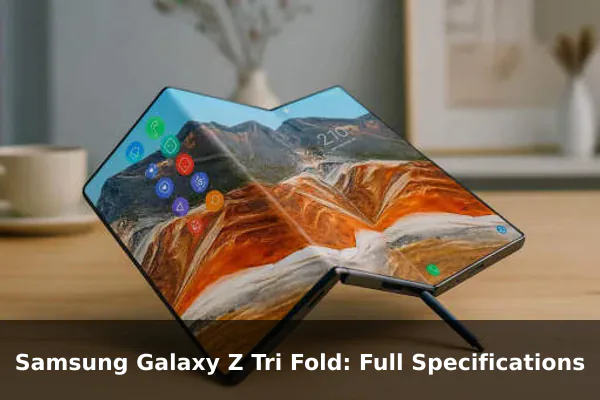
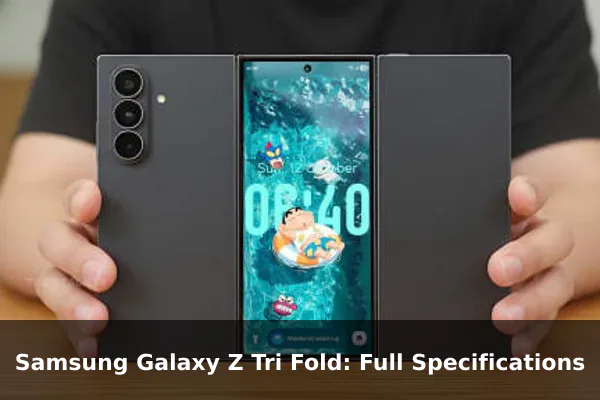
The main event is a 10.0-inch tri-foldable Dynamic LTPO AMOLED 2X panel running at 120Hz with HDR and up to 1600 nits peak brightness, at a 1584 x 2160 resolution (4:3, ~269 ppi). That 4:3 aspect ratio is unusually tablet-like and well suited to documents, reading, and split-screen work. On the outside, a 6.5-inch cover display (1080 x 2520, 422 ppi, up to 2600 nits) handles quick tasks with a sharper, brighter output than the inner screen. The combination lets you choose between glanceable phone use and immersive tablet use without carrying two devices.
Performance and Software
Power comes from the Qualcomm Snapdragon 8 Elite (SM8750-AC, 3 nm) with an octa-core Oryon V2 CPU (2×4.47 GHz + 6×3.53 GHz) and Adreno 830 graphics. It ships with 16GB of RAM in both the 512GB and 1TB UFS configurations, so memory is not a limiting factor for heavy multitasking across the large panel. Software is Android 16 with One UI 8, and Samsung’s long update track record plus DeX wireless make this a credible mobile-productivity hub. There is no microSD slot, so choose storage carefully at purchase.
Camera System
The rear array is a genuine flagship setup: a 200 MP f/1.7 wide with OIS and a large 1/1.3″ sensor, a 10 MP f/2.4 telephoto with 3x optical zoom and OIS, and a 12 MP f/2.2 120-degree ultrawide with dual-pixel PDAF. Video tops out at 8K@30fps and 4K@60fps with 10-bit HDR and HDR10+. For selfies and calls, there is a 10 MP inner ultrawide plus a 10 MP wide cover camera, and the folding design lets you use the powerful rear cameras for high-quality self-portraits on the cover screen.
Battery and Charging
A 5600 mAh Li-Ion battery powers the three panels, which is a reasonable capacity given the space constraints of a dual-hinge chassis. Charging is rated at 45W wired (QC2.0, roughly 50% in 30 minutes), 15W wireless, and 4.5W reverse wireless for topping up accessories. Real-world endurance will depend heavily on how much you use the large inner display, so expect stronger longevity when working mostly on the efficient cover screen.
Connectivity and Extras
Connectivity is comprehensive: 5G (SA/NSA/Sub6), Wi-Fi 7 with tri-band and Wi-Fi Direct, Bluetooth 5.4 with aptX HD, NFC, and USB Type-C. Positioning covers GPS, GALILEO, GLONASS, BDS, and QZSS. Sensors include a side-mounted fingerprint reader, accelerometer, gyro, proximity, compass, and barometer. Stereo speakers are present, but there is no 3.5mm jack and no FM radio. Flexible SIM options span dual Nano-SIM plus eSIM combinations, capped at two active lines at a time.
Value Verdict
At around 2100 EUR, the Galaxy Z Tri Fold is priced as a statement device rather than a mainstream flagship. The value case rests on whether the extra fold and the 10.0-inch canvas meaningfully change how you work and consume media. For power users who will actually exploit the larger screen and DeX, the premium can be justified; for everyone else, a standard book-style foldable or slab flagship offers most of the experience for considerably less.
Conclusion
The Samsung Galaxy Z Tri Fold is a bold, well-equipped attempt at a true pocket-to-tablet device, backed by top-tier silicon, a versatile 200 MP camera, and modern connectivity. Its trade-offs are the ones you would expect from cutting-edge engineering: significant weight, considerable thickness when folded, and an ultra-premium price near 2100 EUR. We recommend it for enthusiasts and mobile professionals who will genuinely use the expansive inner display every day; buyers with more modest needs or budgets should consider a conventional foldable or flagship slab instead. As always, confirm final pricing, availability, and regional specifications with official Samsung channels before purchasing.
References
- Samsung Official Site (Galaxy Z series) – Primary manufacturer source for authoritative Galaxy Z Tri Fold specifications, official pricing, dimensions, display, processor, and camera details.
- Samsung Newsroom – Official Samsung press releases announcing the device, confirming launch specs, availability, and pricing directly from the manufacturer.
- GSMArena – Established smartphone specifications database widely used for structured, cross-checkable technical specs (display, battery, chipset, dimensions).
- The Verge – Reputable consumer-electronics news outlet providing hands-on coverage and independent verification of the device's specifications and features.
- Qualcomm (Snapdragon processor documentation) – Primary source for the chipset/processor specifications powering the device, useful for verifying SoC performance claims.
