
The vivo T4R slides into the competitive sub-200 EUR class with a feature set that, on paper, reads like a phone from a higher price bracket. Announced on July 31, 2025 and released a few days later on August 05, it pairs a slim 7.4 mm body with full IP68/IP69 protection and MIL-STD-810H compliance, a combination still rare at this price. The headline numbers are a 6.77-inch 120Hz AMOLED panel, a MediaTek Dimensity 7400 chip, and a large 5700 mAh battery with 44W charging.
What makes the T4R interesting is not any single standout figure but how it balances durability, screen quality, and endurance without pushing the price up. This article looks past the spec sheet to explain what those numbers mean in everyday use, where vivo made compromises, and which kind of buyer the T4R actually fits.
Full Specifications
Network
| Technology: | GSM / HSPA / LTE / 5G |
| 2G bands: | GSM 850 / 900 / 1800 / 1900 |
| 3G bands: | HSDPA 850 / 900 / 1700(AWS) / 2100 |
| 4G bands: | 1, 3, 5, 8, 19, 28, 38, 40, 41, 42 |
| 5G bands: | 1, 3, 5, 8, 28, 40, 77, 78 SA/NSA |
| Speed: | HSPA, LTE, 5G |
Launch
| Announced: | 2025, July 31 |
| Status: | Available. Released 2025, August 05 |
Body
| Dimensions: | 163.3 x 76.7 x 7.4 mm (6.43 x 3.02 x 0.29 in) |
| Weight: | 183.5 g (6.49 oz) |
| SIM: | Nano-SIM + Nano-SIM |
| IP68/IP69 dust tight and water resistant (high pressure water jets; immersible up to 1.5m for 30 min) MIL-STD-810H compliant* * does not guarantee ruggedness or use in extreme conditions |
Display
| Type: | AMOLED, 1B colors, 120Hz, 2160Hz PWM, HDR10+, 1300 nits (HBM), 1800 nits (peak) |
| Size: | 6.77 inches, 110.9 cm2 (~88.5% screen-to-body ratio) |
| Resolution: | 1080 x 2392 pixels (~388 ppi density) |
| Protection: | Diamond Shield Glass |
Platform
| OS: | Android 15, up to 2 major Android upgrades, Funtouch 15 |
| Chipset: | Mediatek Dimensity 7400 (4 nm) |
| CPU: | Octa-core (4×2.6 GHz Cortex-A78 & 4×2.0 GHz Cortex-A55) |
| GPU: | Mali-G615 MC2 |
Memory
| Card slot: | No |
| Internal: | 128GB 8GB RAM, 256GB 8GB RAM, 256GB 12GB RAM |
| UFS 2.2 |
Main Camera
| Dual: | 50 MP, f/1.8, (wide), 1/1.95″, 0.8µm, PDAF, OIS 2 MP, f/2.4, (depth) |
| Features: | LED flash, HDR, panorama |
| Video: | 4K@30fps, 1080p@30/60fps, gyro-EIS |
Selfie camera
| Single: | 32 MP, f/2.5, (wide) |
| Video: | 4K@30fps, 1080p@30/60fps |
Sound
| Loudspeaker: | Yes, with stereo speakers |
| 3.5mm jack: | No |
Comms
| WLAN: | Wi-Fi 802.11 a/b/g/n/ac/6, dual-band |
| Bluetooth: | 5.4, A2DP, LE |
| Positioning: | GPS, GLONASS, GALILEO, BDS, QZSS |
| NFC: | No |
| Radio: | No |
| USB: | USB Type-C 2.0, OTG |
Features
| Sensors: | Fingerprint (under display, optical), accelerometer, gyro, proximity, compass |
| Circle to Search |
Battery
| Type: | Li-Ion 5700 mAh |
| Charging: | 44W wired Reverse wired Bypass charging |
Misc
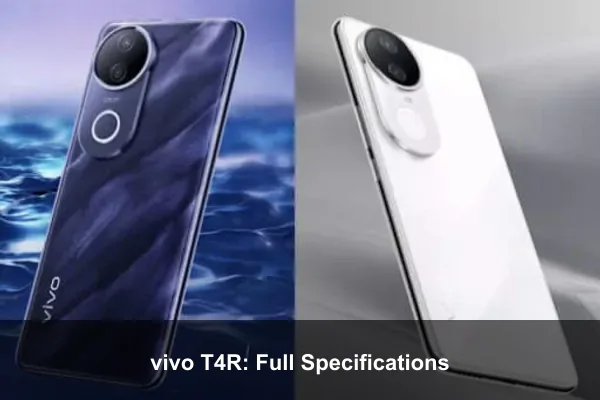
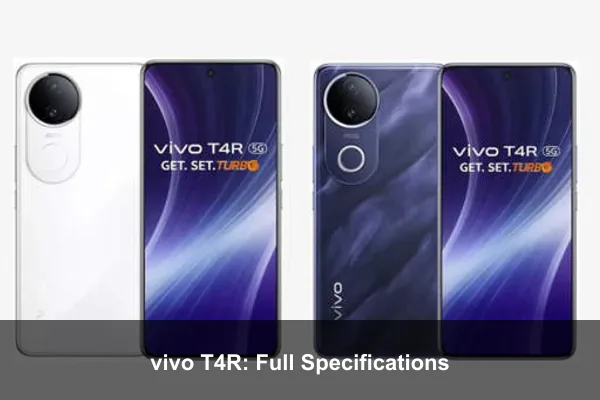
| Colors: | Arctic White, Twilight Blue |
| Price: | About 200 EUR |
Price and Availability
The vivo T4R offers a compelling combination of features and performance. While the base price is around €200, the actual cost may vary depending on your location and retailer. Below, you’ll find the approximate price of the vivo T4R converted into various currencies. Please note that these are estimates based on recent exchange rates as of June 19, 2026 and may not reflect the exact price you’ll find at a retailer.
- United States: $229
- Japan: ¥36,965
- United Kingdom: £173
- Australia: A$327
- Canada: C$324
- Taiwan: NT$7,254
- Denmark: kr1.493
- Saudi Arabia: ﷼860
- South Korea: ₩352,684
- Germany: €200
- Brazil: R$1.181
- Vietnam: ₫6.028.430
- Kenya: KSh 29,800
- India: ₹21,627
- Indonesia: Rp 4.066.588
- Nigeria: ₦310,929
- Pakistan: ₨63,839
- Philippines: ₱13,897
- Bangladesh: ৳২৮,১৭২
Value: What 200 EUR Buys You
At roughly 200 EUR, the vivo T4R asks to be judged against a crowded field of mid-range Android phones. Its trump card is the rare pairing of an IP68/IP69 rating with MIL-STD-810H compliance, meaning it resists not just dust and immersion but also high-pressure water jets. Phones at this price usually offer splash resistance at best, so the T4R immediately differentiates itself for buyers who work outdoors or are simply hard on their devices. Add a high-refresh AMOLED screen and a sizeable battery, and the value proposition is clear: durability and screen quality first, with sensible trade-offs elsewhere.
Design and Build Quality
Measuring 163.3 x 76.7 x 7.4 mm and weighing 183.5 g, the T4R is slim and reasonably light for a phone with a 5700 mAh cell. That is an impressive engineering balance, since large batteries usually add bulk. The dual Nano-SIM tray keeps it travel-friendly, and the two colorways, Arctic White and Twilight Blue, lean clean and understated rather than flashy. The ruggedized rating is the real story here: few rivals near 200 EUR survive the same dust, immersion, and high-pressure water tests, making the T4R a dependable daily companion.
Display: A Bright, Smooth AMOLED
The 6.77-inch AMOLED display is the centerpiece. With a 120Hz refresh rate, scrolling and animations feel fluid, while the 1080 x 2392 resolution (~388 ppi) keeps text crisp. vivo quotes 1300 nits in high-brightness mode and 1800 nits peak, which should make outdoor visibility a non-issue. HDR10+ support, 1B colors, and 2160Hz PWM dimming round out a panel that punches above its price for both media and eye comfort. Diamond Shield Glass protection adds a layer of scratch resistance that complements the rugged body.
Performance and Software
Powering the T4R is the MediaTek Dimensity 7400, built on an efficient 4 nm process, paired with a Mali-G615 MC2 GPU. The octa-core layout (4×2.6 GHz Cortex-A78 and 4×2.0 GHz Cortex-A55) is tuned for smooth everyday performance rather than flagship gaming. Memory options span 8GB/128GB, 8GB/256GB, and 12GB/256GB, though storage uses UFS 2.2 and there is no microSD expansion, so picking the right capacity up front matters. It ships with Android 15 and Funtouch 15, with a promise of up to two major OS upgrades; that update window is modest, so longevity-focused buyers should factor it in.
Camera Capabilities
The rear setup is a 50 MP f/1.8 main sensor with a large 1/1.95″ footprint, PDAF, and crucially OIS, joined by a 2 MP depth helper. OIS at this price is a welcome inclusion that should steady low-light shots and video. Recording tops out at 4K@30fps with gyro-EIS, and the 32 MP front camera also handles 4K, which is generous for selfies and vlogging. The omission of a dedicated ultrawide lens is the clearest camera compromise, so framing flexibility is limited compared with some rivals.
Battery and Charging
A 5700 mAh Li-Ion battery should comfortably deliver a full day, often more, of mixed use thanks to the efficient 4 nm chip. The 44W wired charging is quick enough to refill meaningfully over a coffee break, and the phone adds reverse wired charging plus bypass charging, which can reduce heat and battery wear during long gaming sessions. There is no wireless charging, but that is expected in this segment.
Connectivity
The T4R covers 5G across both SA and NSA networks, alongside Wi-Fi 6, Bluetooth 5.4, and comprehensive positioning (GPS, GLONASS, GALILEO, BDS, QZSS). Stereo speakers improve media playback. However, the trade-offs are notable: there is no NFC, no FM radio, no 3.5mm jack, and USB-C stays at the slower 2.0 standard. The missing NFC in particular may deter buyers who rely on tap-to-pay.
Who Should Buy the vivo T4R
The T4R is ideal for buyers who prioritize durability, a great screen, and long battery life on a tight budget. Outdoor workers, students, and anyone rough on phones will appreciate the rugged certifications. Those who need contactless payments, an ultrawide camera, or a long software-support runway should weigh the gaps carefully before committing.
Conclusion
The vivo T4R is a focused value pick that spends its budget where it counts: a tough IP68/IP69 and MIL-STD-810H body, a bright 120Hz AMOLED, OIS-backed cameras, and a big 5700 mAh battery with 44W charging. The compromises, no NFC, no ultrawide, UFS 2.2 storage, and only two OS upgrades, are real but predictable at 200 EUR. If you want a rugged, media-friendly daily phone and can live without tap-to-pay, the T4R is an easy recommendation; if NFC or camera versatility tops your list, look elsewhere in the segment.
