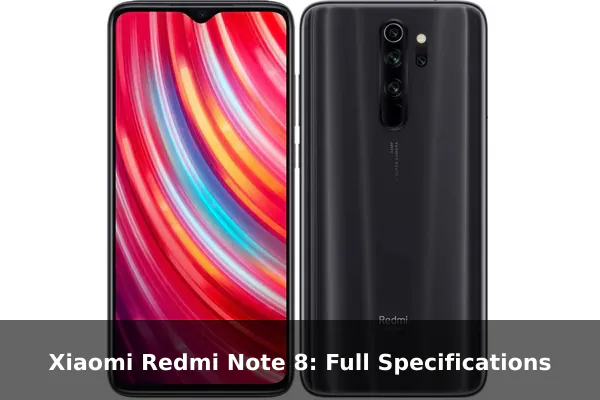
The Xiaomi Redmi Note 8 arrived in October 2019 as one of the most accessible 48 MP camera phones on the market, pairing a Qualcomm Snapdragon 665 chipset with a 6.3-inch Full HD+ display and a 4,000 mAh battery. Although it has since been discontinued, it remains a frequently discussed device in the budget segment because of its glass sandwich build, quad rear camera setup, and the longevity of the MIUI software cycle.
This guide focuses on what the Redmi Note 8 actually delivers in everyday use, how its hardware decisions hold up several years after launch, and where it sits compared with newer entry-level Redmi models. The original European launch price was about 220 EUR, which makes it a useful reference point when judging today’s used and refurbished offers.
Full Specifications
Network
| Technology |
GSM / HSPA / LTE |
| 2G bands |
GSM 850 / 900 / 1800 / 1900 |
| 3G bands |
HSDPA 850 / 900 / 1700(AWS) / 1900 / 2100 |
|
HSDPA 850 / 900 / 2100 |
| 4G bands |
1, 2, 3, 4, 5, 7, 8, 20, 38, 40 |
|
1, 3, 5, 8, 38, 40, 41 |
| Speed |
HSPA 42.2/5.76 Mbps, LTE (4CA) Cat12 600/50 Mbps |
Launch
| Announced |
2019, August 29. Released 2019, October 16 |
| Status |
Discontinued |
Body
| Dimensions |
158.3 x 75.3 x 8.4 mm (6.23 x 2.96 x 0.33 in) |
| Weight |
190 (6.70 oz) |
| Build |
Glass front (Gorilla Glass 5), glass back (Gorilla Glass 5), plastic frame |
| SIM |
Nano-SIM + Nano-SIM |
Display
| Type |
IPS LCD |
| Size |
6.3 inches, 97.4 cm2 (~81.7% screen-to-body ratio) |
| Resolution |
1080 x 2340 pixels, 19.5:9 ratio (~409 ppi density) |
| Protection |
Corning Gorilla Glass 5 |
Platform
| OS |
Android 9.0 (Pie), upgradable to Android 11, MIUI 12.5 |
| Chipset |
Qualcomm SDM665 Snapdragon 665 (11 nm) |
| CPU |
Octa-core (4×2.0 GHz Kryo 260 Gold & 4×1.8 GHz Kryo 260 Silver) |
| GPU |
Adreno 610 |
Memory
| Card slot |
microSDXC (dedicated slot) |
| Internal |
32GB 3GB RAM, 64GB 4GB RAM, 64GB 6GB RAM, 128GB 4GB RAM, 128GB 6GB RAM |
|
eMMC 5.1 |
Main Camera
| Quad |
48 MP, f/1.8, 26mm (wide), 1/2.0", 0.8µm, PDAF 8 MP, f/2.2, 120˚ (ultrawide), 1/4.0", 1.12µm 2 MP (macro) Auxiliary lens |
| Features |
LED flash, HDR, panorama |
| Video |
4K@30fps, 1080p@30/60/120fps; gyro-EIS |
Selfie camera
| Single |
13 MP, f/2.0, (wide), 1/3.1", 1.12µm |
| Features |
HDR, panorama |
| Video |
1080p@30fps |
Sound
| Loudspeaker |
Yes |
| 3.5mm jack |
Yes |
Comms
| WLAN |
Wi-Fi 802.11 a/b/g/n/ac, dual-band, Wi-Fi Direct |
| Bluetooth |
4.2, A2DP, LE |
| Positioning |
GPS, GLONASS, BDS |
| NFC |
No |
| Infrared port |
Yes |
| Radio |
FM radio |
| USB |
USB Type-C 2.0, OTG |
Features
| Sensors |
Fingerprint (rear-mounted), accelerometer, gyro, proximity, compass |
Battery
| Type |
Li-Po 4000 mAh, non-removable |
| Charging |
18W wired |
Misc
| Colors |
Neptune Blue, Moonlight White, Space Black, Nebula Purple, Cosmic Purple |
| Models |
M1908C3JH, M1908C3JG, M1908C3JI |
| SAR |
0.26 W/kg (head) 1.00 W/kg (body) |
| SAR EU |
0.19 W/kg (head) 1.09 W/kg (body) |
| Price |
About 220 EUR |
Our Tests
| Performance |
AnTuTu: 141915 (v7), 161572 (v8) GeekBench: 5590 (v4.4), 1339 (v5.1) GFXBench: 5.9fps (ES 3.1 onscreen) |
| Display |
Contrast ratio: 1521:1 (nominal) |
| Camera |
Photo / Video |
| Loudspeaker |
Voice 78dB / Noise 72dB / Ring 81dB |
| Audio quality |
Noise -94.0dB / Crosstalk -93.3dB |
| Battery (old) |
Endurance rating 108h |
Price and Availability
The Xiaomi Redmi Note 8 offers a compelling combination of features and performance. While the base price is around €220, the actual cost may vary depending on your location and retailer. Below, you’ll find the approximate price of the Xiaomi Redmi Note 8 converted into various currencies. Please note that these are estimates based on recent exchange rates as of June 1, 2026 and may not reflect the exact price you’ll find at a retailer.
- United States: $256
- Japan: ¥40,850
- United Kingdom: £191
- Australia: A$357
- Canada: C$354
- Taiwan: NT$8,047
- Denmark: kr1.641
- Saudi Arabia: ﷼961
- South Korea: ₩386,304
- Germany: €220
- Brazil: R$1.292
- Vietnam: ₫6.704.244
- Kenya: KSh 33,177
- India: ₹24,341
- Indonesia: Rp 4.575.900
- Nigeria: ₦350,296
- Pakistan: ₨71,368
- Philippines: ₱15,767
- Bangladesh: ৳৩১,৪৫২
Value Proposition in the Budget Segment
At its announcement, the Redmi Note 8 undercut most rivals that offered a 48 MP main camera, Gorilla Glass 5 on both sides, and a Full HD+ panel. With an original price tag around 220 EUR, it positioned itself as a value-first device aimed at users upgrading from older entry-level phones. On the second-hand market it now competes with newer 4G Redmi and Realme models, so the appeal today depends heavily on local pricing and battery health.
Design and Build Quality
Measuring 158.3 x 75.3 x 8.4 mm and weighing 190 g, the Redmi Note 8 uses a glass front and back protected by Corning Gorilla Glass 5, wrapped around a plastic frame. The color lineup includes Neptune Blue, Moonlight White, Space Black, Nebula Purple, and Cosmic Purple, with a gradient finish that was uncommon at this price point in 2019. A rear-mounted fingerprint sensor, a 3.5 mm headphone jack, and an IR blaster round out a practical hardware layout.
Display Experience
The 6.3-inch IPS LCD runs at 1080 x 2340 pixels in a 19.5:9 aspect ratio, giving roughly 409 ppi and an 81.7% screen-to-body ratio. Xiaomi’s measured contrast ratio of 1521:1 keeps text and UI elements crisp for reading, browsing, and video. There is no high refresh rate option, which is the main concession compared with newer Redmi Note models, but the panel remains comfortable for general use thanks to its sharp resolution and Gorilla Glass 5 protection.
Performance with Snapdragon 665
The Qualcomm Snapdragon 665 is an 11 nm chip with four 2.0 GHz Kryo 260 Gold cores, four 1.8 GHz Kryo 260 Silver cores, and an Adreno 610 GPU. In Xiaomi’s own benchmark results it reached around 161,572 in AnTuTu v8 and 1,339 in Geekbench 5.1 single-thread, which translates to smooth performance for messaging, browsing, social media, and light multitasking. Heavier 3D games will need lowered graphics settings, especially on the 3 GB RAM configuration; the 4 GB and 6 GB variants paired with eMMC 5.1 storage offer a noticeably more comfortable experience.
Quad Camera System
The Redmi Note 8 was an early mass-market adopter of a 48 MP main sensor at f/1.8 with PDAF, joined by an 8 MP ultrawide with a 120-degree field of view, a 2 MP macro camera, and an auxiliary depth lens. Video recording tops out at 4K at 30fps, with 1080p available at 30, 60, and 120fps, plus gyro-based EIS to steady handheld clips. On the front, a 13 MP f/2.0 selfie camera captures 1080p video at 30fps and supports HDR and panorama modes.
Battery Life and Charging
A 4,000 mAh non-removable Li-Po battery powers the device, paired with 18 W wired charging. Xiaomi’s published endurance rating sits at 108 hours, which reflects strong day-to-day stamina for calls, web use, and standby on the Snapdragon 665’s efficient 11 nm process. Owners considering a used unit should remember that lithium batteries degrade over time, so a fresh cell or a verified battery health report matters more than the original spec.
Software and Updates
The Redmi Note 8 shipped with Android 9.0 Pie under MIUI and was officially updated to Android 11 with MIUI 12.5. Xiaomi has since discontinued the model, so buyers today should plan around that final supported version rather than expecting further major OS upgrades. Security patches and app compatibility will continue to evolve through Google Play services and individual app updates, but enterprise users with strict patch requirements should weigh this carefully.
Connectivity Options
Connectivity covers 4G LTE Cat12 with download speeds up to 600 Mbps, dual-band Wi-Fi 802.11 a/b/g/n/ac, Bluetooth 4.2 with A2DP and LE, and tri-system positioning with GPS, GLONASS, and BDS. The Redmi Note 8 also retains an FM radio, a 3.5 mm headphone jack, and a USB Type-C 2.0 port with OTG. NFC is absent on this model, which is the main caveat for users who rely on contactless payments or pairing accessories via NFC tap.
Who Should Buy the Redmi Note 8
This phone makes the most sense for buyers who want a cheap secondary device, a backup for travel, or a first smartphone for a family member, especially when found at a low refurbished price. The combination of Gorilla Glass 5, a Full HD+ display, an IR blaster, and an audio jack still covers a wide range of practical needs. Users who depend on NFC payments, want long-term Android updates, or play demanding mobile games should look at newer Redmi Note generations instead.
Conclusion
The Xiaomi Redmi Note 8 remains a sensibly engineered budget phone built around a Snapdragon 665, a 48 MP quad camera, a 4,000 mAh battery, and Gorilla Glass 5 on both faces. As a discontinued 2019 release stuck on MIUI 12.5 based on Android 11, it is best treated as an affordable secondary or starter device rather than a primary daily driver. If you can find a well-maintained unit at a clearly discounted price and you do not need NFC or the latest Android version, it still delivers competent everyday performance for the money.
Official references