
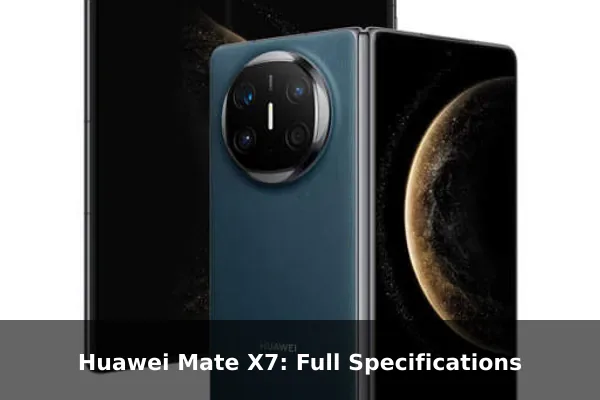
The Huawei Mate X7 is a premium book-style foldable built around a large 8.0-inch inner OLED display, a practical 6.49-inch cover screen, and a high-end camera system. It is positioned as a productivity-first flagship rather than a compact phone, with a slim unfolded profile, stereo speakers, advanced satellite features in China, and a launch price context of about 1590 EUR.
Its most important story is not just raw power, but regional variation. International buyers get EMUI 15 and eSIM support, while the China model runs HarmonyOS 6.0, supports China-only 5G details, and includes BDS satellite messaging. That makes the Mate X7 a strong device on paper, but one that should be checked carefully against local network and software expectations before buying.
Full Specifications
Network
| Technology: | GSM / CDMA / HSPA / EVDO / LTE / 5G |
| 2G bands: | GSM 850 / 900 / 1800 / 1900 |
| CDMA 800 | |
| 3G bands: | HSDPA 800 / 850 / 900 / 1700(AWS) / 1900 / 2100 |
| CDMA2000 1xEV-DO | |
| 4G bands: | 1, 2, 3, 4, 5, 6, 7, 8, 9, 12, 13, 17, 18, 19, 20, 26, 28, 34, 38, 39, 40, 41, 42, 48, 66 |
| 5G bands: | SA/NSA – China model only |
| Speed: | HSPA, LTE, 5G (China only) |
Launch
| Announced: | 2025, November 25 |
| Status: | Available. Released 2025, November 26 |
Body
| Dimensions: | Unfolded: 156.8 x 144.2 x 4.5 mmFolded: 156.8 x 73.8 x 9.5 mm |
| Weight: | 236 g (8.32 oz) |
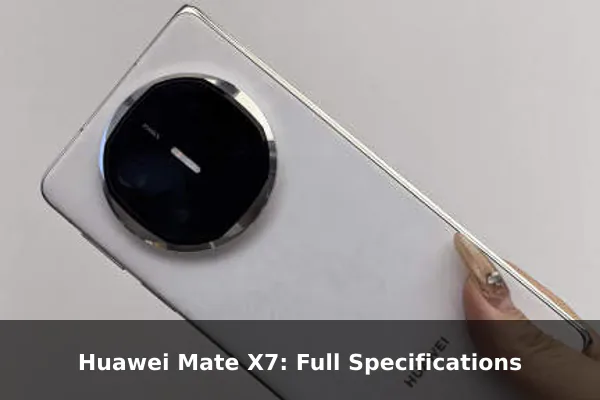
| Build: | Glass front, nylon fiber or silicone polymer back (eco leather), aluminum frame |
| SIM: | · Nano-SIM + Nano-SIM + eSIM (max 2 at a time) – International· Nano-SIM + Nano-SIM – China |
| IP58/IP59 dust protected and water resistant (high pressure water jets; immersible up to 2m for 30 min) Aerospace-grade aluminum |
Display
| Type: | Foldable LTPO OLED, 1B colors, 120Hz, 1440Hz PWM, HDR Vivid, 2500 nits (peak) |
| Size: | 8.0 inches, 202.7 cm2 (~89.6% screen-to-body ratio) |
| Resolution: | 2210 x 2416 pixels (~412 ppi density) |
| Cover display: LTPO OLED, 120Hz, 1440Hz PWM, HDR, 3000 nits (peak), 6.49 inches, 1080 x 2444 pixels, Kunlun Glass 2, 412 ppi |
Platform
| OS: | EMUI 15 (International), HarmonyOS 6.0 (China) |
| Chipset: | Kirin 9030 Pro (6 nm) |
| CPU: | 9-core (1×2.75 GHz & 4×2.27 GHz & 4×1.72 GHz) |
| GPU: | Maleoon 935 |
Memory
| Card slot: | No |
| Internal: | 256GB 12GB RAM, 512GB 12GB RAM, 512GB 16GB RAM, 1TB 16GB RAM, 1TB 20GB RAM |
| UFS 4.x |
Main Camera
| Triple: | 50 MP, f/1.5-f/4.0, 24mm (wide), 1/1.28″, PDAF, OIS* 50 MP, f/2.2, 81mm (periscope telephoto), PDAF, OIS, 3.5x optical zoom 40 MP, f/2.2, 13mm, 120˚ (ultrawide), PDAF *f/1.4-f/4.0 and 1/1.56″ sensor size for 12GB RAM model (China only) |
| Features: | Laser AF, color spectrum sensor, LED flash, panorama, HDR |
| Video: | 4K, 1080p, 1080p@960fps, HDR, gyro-EIS, OIS, HDR Vivid |
Selfie camera
| Single: | 8 MP, f/2.2, (wide) Cover camera: 8 MP, f/2.4, (wide) |
| Features: | HDR, panorama |
| Video: | 4K, 1080p |
Sound
| Loudspeaker: | Yes, with stereo speakers |
| 3.5mm jack: | No |
Comms
| WLAN: | Wi-Fi 802.11 a/b/g/n/ac/6/7, dual-band, Wi-Fi Direct |
| Bluetooth: | 6.0, A2DP, LE, L2HC |
| Positioning: | GPS (L1+L5), GLONASS (L1), BDS (B1I+B1c+B2a+B2b), GALILEO (E1+E5a+E5b), QZSS (L1+L5), NavIC |
| NFC: | Yes |
| Infrared port: | Yes |
| Radio: | No |
| USB: | USB Type-C 3.1, OTG, DisplayPort 1.2 |
Features
| Sensors: | Fingerprint (side-mounted), accelerometer, gyro, proximity, compass, barometer |
| BDS Satellite and Messaging – China only |
Battery
| Type: | 5600 mAh or 5525 mAh (12GB RAM model only) |
| Charging: | 66W wired 50W wireless 7.5W reverse wireless 5W reverse wired |
Misc
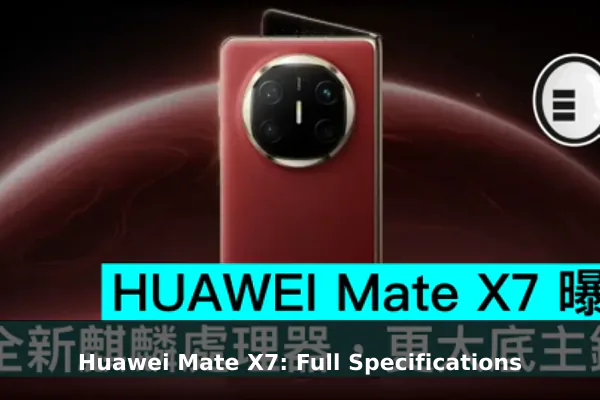
| Colors: | Black, Brocade White, Nebula Red, Purple, Blue |
| Models: | DEL-AL10, DEL-LX9 |
| Price: | About 1590 EUR |
Our Tests
| Loudspeaker: | -25.1 LUFS (Very good) |
| Battery: | Active use score 11:51h |
Price and Availability
The Huawei Mate X7 offers a compelling combination of features and performance. While the base price is around €1.590, the actual cost may vary depending on your location and retailer. Below, you’ll find the approximate price of the Huawei Mate X7 converted into various currencies. Please note that these are estimates based on recent exchange rates as of September 26, 2026 and may not reflect the exact price you’ll find at a retailer.
- United States: $1,812
- Japan: ¥285,468
- United Kingdom: £1,368
- Australia: A$2,578
- Canada: C$2,561
- Taiwan: NT$57,544
- Denmark: kr11.886
- Saudi Arabia: ﷼6,797
- South Korea: ₩2,463,046
- Germany: €1.590
- Brazil: R$9.404
- Vietnam: ₫47.055.264
- Kenya: KSh 235,446
- India: ₹1,73,542
- Indonesia: Rp 32.383.070
- Nigeria: ₦2,474,049
- Pakistan: ₨501,655
- Philippines: ₱113,363
- Bangladesh: ৳২,২২,৯৬৬
Value and Positioning
The Huawei Mate X7 sits in the expensive foldable class, so its value depends on whether the larger screen genuinely replaces a small tablet or improves daily multitasking. The raw price data points to about 1590 EUR, placing it well above mainstream flagships and into direct competition with premium foldables from Samsung, Google, Honor, vivo, and Oppo. Huawei answers that price with a lightweight 236 g body, two high-refresh OLED panels, a triple 50 MP-class camera setup, fast wired and wireless charging, and large storage options up to 1 TB.
This is not the best match for someone who only wants a powerful phone for messaging, photography, and social apps. It makes more sense for users who read documents, handle spreadsheets, edit photos, watch video, or need a big canvas that still folds into a pocketable shape. The strongest value angle is the combination of a very large inner screen and a full-featured cover display, meaning the device can work like a normal phone when closed and like a compact tablet when open.
Design and Durability
The Mate X7 measures 156.8 x 73.8 x 9.5 mm when folded and opens to 156.8 x 144.2 x 4.5 mm, making it notably thin in tablet mode. Its 236 g weight is respectable for an 8-inch foldable, though it will still feel denser than many slab-style flagships. Huawei lists a glass front, aluminum frame, and either nylon fiber or silicone polymer eco-leather style back material, depending on version.
Durability is one of the more interesting parts of the package. The phone carries IP58/IP59 protection, described as dust protected and water resistant, including high-pressure water jets and immersion up to 2 m for 30 minutes. That rating gives it a stronger durability story than older foldables, although any foldable remains more mechanically complex than a conventional phone. The cover screen also uses Kunlun Glass 2, which helps the closed-phone experience feel less fragile in daily use.
Dual Display Experience
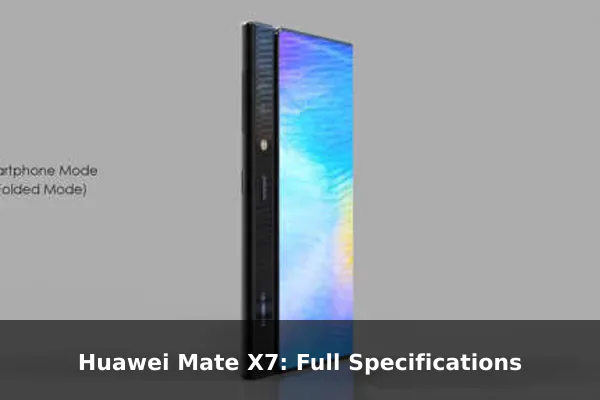
The internal display is an 8.0-inch foldable LTPO OLED panel with 1 billion colors, 120 Hz refresh rate, 1440 Hz PWM dimming, HDR Vivid support, and a listed 2500 nits peak brightness. Its 2210 x 2416 resolution works out to around 412 ppi, so the panel should look sharp enough for text-heavy use as well as media. The square-ish unfolded format is especially useful for reading, split-screen work, maps, and photo previews.
The cover display is not an afterthought. It is a 6.49-inch LTPO OLED panel with 120 Hz refresh rate, HDR support, 1440 Hz PWM dimming, 3000 nits peak brightness, 1080 x 2444 resolution, Kunlun Glass 2, and the same 412 ppi density. That matters because foldables are only convenient if the outer screen feels complete. Here, the cover display should be comfortable for quick replies, calls, browsing, camera framing, and one-handed tasks before opening the main screen for deeper work.
Performance and Storage
The Huawei Mate X7 uses the Kirin 9030 Pro chipset, built on a 6 nm process, with a 9-core CPU configuration listed as 1×2.75 GHz, 4×2.27 GHz, and 4×1.72 GHz. Graphics are handled by the Maleoon 935 GPU. On paper, this is a flagship-class Huawei platform, but buyers comparing it to the latest Snapdragon or Apple silicon devices should look at real-world app compatibility, gaming performance, and thermal behavior rather than relying only on core counts.
Memory choices are broad: 256 GB with 12 GB RAM, 512 GB with 12 GB RAM, 512 GB with 16 GB RAM, 1 TB with 16 GB RAM, and 1 TB with 20 GB RAM. Storage is listed as UFS 4.x, and there is no microSD card slot. For a foldable designed around productivity, the 512 GB models look like the practical baseline, especially for users who shoot 4K video, keep offline media, or handle large work files.
Camera System
The rear camera setup is built around three useful focal ranges. The main camera is a 50 MP wide sensor with variable aperture, PDAF, and OIS. The telephoto camera is also 50 MP, with an 81 mm periscope lens, PDAF, OIS, and 3.5x optical zoom. The ultrawide camera is a 40 MP 13 mm unit with a 120-degree field of view and PDAF. That gives the Mate X7 a stronger camera range than foldables that compromise heavily on zoom or ultrawide quality.
Huawei also lists Laser AF, a color spectrum sensor, LED flash, panorama, HDR, and video capture up to 4K, plus 1080p, 1080p at 960 fps, HDR, gyro-EIS, OIS, and HDR Vivid. The front camera is 8 MP on the inner display, with a separate 8 MP cover camera. These selfie cameras are adequate on paper, but the rear camera system is clearly the highlight, particularly because a foldable can use its cover screen as a viewfinder for higher-quality rear-camera selfies.
Battery and Charging
Battery capacity is listed as 5600 mAh, with a 5525 mAh version for the 12 GB RAM model only. That is a strong capacity for a foldable this thin, and the supplied test data gives an active use score of 11:51h. Actual endurance will vary heavily depending on whether the inner display or cover display is used more often, but the number suggests the Mate X7 is designed for a full mixed-use day rather than short-session battery anxiety.
Charging support is broad: 66 W wired, 50 W wireless, 7.5 W reverse wireless, and 5 W reverse wired. That makes the phone flexible for desk charging, travel top-ups, and accessory charging. The reverse wireless speed is modest, but useful for earbuds or emergency phone-to-phone sharing. For a foldable, the combination of large battery capacity and fast wireless charging is one of the more premium parts of the package.
Software and Regional Differences
The software experience depends on region. The international model is listed with EMUI 15, while the China model uses HarmonyOS 6.0. This distinction matters more than a normal Android skin difference because Huawei phones can vary significantly in app services, ecosystem features, and preloaded software behavior by market. Buyers outside China should check their required banking apps, workplace apps, messaging services, and cloud tools before committing.
SIM support also changes by region. The international version supports Nano-SIM + Nano-SIM + eSIM, with a maximum of two active at the same time, while the China version supports Nano-SIM + Nano-SIM. The China model also gets BDS satellite and messaging features. This gives the Chinese variant extra emergency and remote-area appeal, but international users should not assume every regional feature transfers globally.
Connectivity and Media
Network support includes GSM, CDMA, HSPA, EVDO, LTE, and 5G, though the 5G listing is marked as SA/NSA for the China model only. LTE band coverage is wide, including bands 1, 2, 3, 4, 5, 7, 8, 20, 28, 38, 39, 40, 41, 42, 48, and 66 among others. Even so, foldable buyers importing the phone should verify local carrier compatibility rather than assuming full 5G or VoLTE behavior.
Local connectivity is high-end, with Wi-Fi 7, Bluetooth 6.0, NFC, infrared, extensive multi-band satellite positioning, and USB Type-C 3.1 with OTG and DisplayPort 1.2. The stereo speakers are backed by a measured loudspeaker result of -25.1 LUFS, rated very good in the supplied test data. There is no 3.5 mm headphone jack, which is expected in this class but still worth noting for wired-audio users.
Who Should Buy the Huawei Mate X7?
The Mate X7 is best for users who want a foldable for real work, not just novelty. It suits people who frequently read long documents, compare information side by side, manage travel or business tasks, review photos, or want a tablet-like screen without carrying a second device. It also appeals to Huawei ecosystem users who are comfortable with EMUI or HarmonyOS and value the brand’s camera processing and hardware design.
It is less ideal for buyers who need guaranteed Google-centric app behavior, the broadest global 5G certainty, the lowest possible price, or the simplest durable phone. It is also not the obvious gaming-first choice without independent performance testing against Snapdragon-powered rivals. The Mate X7 is a specialist flagship: impressive, capable, and premium, but best purchased with clear awareness of regional software and network differences.
References
- Huawei official Mate X7 specifications: https://consumer.huawei.com/sg/phones/mate-x7/specs/
- Source catalog record: https://tampungspekhp.berkasdrive.com/?action=ambil_postingan&id=8059
- PhoneArena Huawei Mate X7 reference page: https://www.phonearena.com/phones/Huawei-Mate-X7_id12888
Conclusion
The Huawei Mate X7 is a premium foldable with a large 8-inch OLED display, a bright and capable cover screen, strong camera hardware, fast charging, and a durable-looking body for its category. Its biggest strengths are productivity, display quality, battery capacity, and camera versatility, while its biggest caveats are price, regional software differences, and China-only 5G and satellite details. Recommended for Huawei fans and productivity-focused foldable buyers who have checked local app and carrier support first.
