
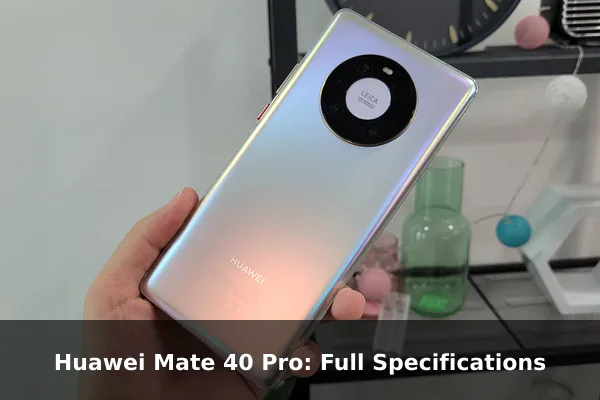
The Huawei Mate 40 Pro arrived in late 2020 as the brand’s flagship swan song built around the in-house Kirin 9000 5G silicon, and it still stands as one of the most ambitious devices Huawei has shipped. Announced on 22 October 2020 and released on 1 November 2020, it combined a curved 6.76-inch OLED panel, a Leica-tuned camera array, and 66W wired charging in a body rated IP68 for dust and water resistance.
What makes the Mate 40 Pro interesting in 2026 is how its hardware ages against the trade-off it imposed: no Google Play Services. This deep-dive looks at the design, display, performance, imaging, battery endurance, and connectivity story to help you decide whether the roughly 790 EUR launch flagship is still worth seeking out on the second-hand market.
Full Specifications
Network
| Technology | GSM / CDMA / HSPA / EVDO / LTE / 5G |
| 2G bands | GSM 850 / 900 / 1800 / 1900 |
| CDMA 800 | |
| 3G bands | HSDPA 800 / 850 / 900 / 1700(AWS) / 1900 / 2100 |
| CDMA2000 1xEV-DO | |
| 4G bands | 1, 2, 3, 4, 5, 6, 7, 8, 9, 12, 17, 18, 19, 20, 26, 28, 32, 34, 38, 39, 40, 41, 42 |
| 5G bands | 1, 3, 5, 7, 8, 28, 38, 40, 41, 77, 78, 79, 80, 84 SA/NSA/Sub6 |
| Speed | HSPA, LTE, 5G |
Launch
| Announced | 2020, October 22 |
| Status | Available. Released 2020, November 01 |
Body
| Dimensions | 162.9 x 75.5 x 9.1 mm (Glass) / 9.5mm (Leather) |
| Weight | 212 g (7.48 oz) |
| Build | Glass front, glass back or eco leather back, aluminum frame |
| SIM | · Nano-SIM + eSIM· Nano-SIM + Nano-SIM |
| IP68 dust tight and water resistant (immersible up to 1.5m for 30 min) |
Display
| Type | OLED, HDR10, 90Hz |
| Size | 6.76 inches, 115.7 cm2 (~94.1% screen-to-body ratio) |
| Resolution | 1344 x 2772 pixels, 18.5:9 ratio (~456 ppi density) |
Platform
| OS | Android 10, EMUI 11, no Google Play Services |
| Chipset | Kirin 9000 5G (5 nm) |
| CPU | Octa-core (1×3.13 GHz Cortex-A77 & 3×2.54 GHz Cortex-A77 & 4×2.05 GHz Cortex-A55) |
| GPU | Mali-G78 MP24 |
Memory
| Card slot | Nano Memory (uses shared SIM slot) |
| Internal | 128GB 8GB RAM, 256GB 8GB RAM, 512GB 8GB RAM |
| UFS 3.1 |
Main Camera
| Triple | 50 MP, f/1.9, 23mm (wide), 1/1.28", 1.22µm, multi-directional PDAF 12 MP, f/3.4, 125mm (periscope telephoto), PDAF, OIS, 5x optical zoom 20 MP, f/1.8, 18mm (ultrawide), PDAF |
| Features | Laser AF, color spectrum sensor, Leica optics, LED flash, panorama, HDR |
| Video | 4K@30/60fps, 1080p@30/60/120/240/480fps, 720p@960fps, 720p@3840fps, HDR, gyro-EIS |
Selfie camera
| Single | 13 MP, f/2.4, 18mm (ultrawide) TOF 3D, (depth/biometrics sensor) |
| Features | HDR, panorama |
| Video | 4K@30/60fps, 1080p@30/60/240fps |
Sound
| Loudspeaker | Yes, with stereo speakers |
| 3.5mm jack | No |
| 32-bit/384kHz audio |
Comms
| WLAN | Wi-Fi 802.11 a/b/g/n/ac/6, dual-band, Wi-Fi Direct |
| Bluetooth | 5.2, A2DP, LE |
| Positioning | GPS (L1+L5), GLONASS (L1), BDS (B1I+B1c+B2a+B2b), GALILEO (E1+E5a+E5b), QZSS (L1+L5), NavIC |
| NFC | Yes |
| Infrared port | Yes |
| Radio | No |
| USB | USB Type-C 3.1, OTG |
Features
| Sensors | Face ID, fingerprint (under display, optical), accelerometer, gyro, proximity, barometer, compass |
Battery
| Type | Li-Po 4400 mAh |
| Charging | 66W wired 50W wireless 5W reverse wireless |
Misc
| Colors | Mystic Silver, White, Black, Green, Yellow |
| Models | NOH-NX9, NOH-AN00, NOH-AN01 |
| Price | About 790 EUR |
Our Tests
| Performance | AnTuTu: 686835 (v8) GeekBench: 3704 (v5.1) GFXBench: 43fps (ES 3.1 onscreen) |
| Display | 807 nits max brightness (measured) |
| Camera | Photo / Video |
| Loudspeaker | -24.9 LUFS (Very good) |
| Battery (old) | Endurance rating 97h |
Price and Availability
The Huawei Mate 40 Pro offers a compelling combination of features and performance. While the base price is around €790, the actual cost may vary depending on your location and retailer. Below, you’ll find the approximate price of the Huawei Mate 40 Pro converted into various currencies. Please note that these are estimates based on recent exchange rates as of June 4, 2026 and may not reflect the exact price you’ll find at a retailer.
- United States: $917
- Japan: ¥146,676
- United Kingdom: £683
- Australia: A$1,284
- Canada: C$1,273
- Taiwan: NT$28,852
- Denmark: kr5.896
- Saudi Arabia: ﷼3,438
- South Korea: ₩1,402,565
- Germany: €790
- Brazil: R$4.613
- Vietnam: ₫23.983.131
- Kenya: KSh 118,754
- India: ₹87,751
- Indonesia: Rp 16.482.425
- Nigeria: ₦1,246,960
- Pakistan: ₨255,659
- Philippines: ₱56,643
- Bangladesh: ৳১,১২,৫৬৪
Value and Market Position
At launch the Mate 40 Pro carried an indicative price of about 790 EUR, positioning it directly against the Samsung Galaxy Note 20 Ultra and Apple iPhone 12 Pro of its era. According to Huawei’s official product page, the Mate 40 Pro was the brand’s premium handset for late 2020, and its value today depends heavily on how comfortable a buyer is sideloading apps in place of Google services. Used pricing has softened considerably, which makes the hardware compelling on a cost-per-spec basis.
Design and Build Quality
Measuring 162.9 x 75.5 x 9.1 mm in the glass version (9.5 mm in the eco-leather variant) and weighing 212 g, the Mate 40 Pro uses a glass front, an aluminum frame, and either a glass or vegan-leather back. The signature element is the deeply curved Horizon display that wraps over both edges. The phone is IP68 rated, with Huawei specifying immersion up to 1.5 m for 30 minutes, an enclosure standard defined by IEC 60529. Colors offered at launch included Mystic Silver, White, Black, Green, and Yellow.
Display Experience
The 6.76-inch OLED panel runs at 1344 x 2772 pixels in an 18.5:9 aspect, yielding roughly 456 ppi. Refresh rate is 90Hz with HDR10 support, and Huawei reports a screen-to-body ratio near 94.1%. Independent panel measurements put peak brightness around 807 nits, which keeps the display comfortably legible outdoors. The curved glass cuts visible bezels dramatically, although it does introduce the usual edge-glare trade-off familiar from waterfall-style designs.
Performance and Software
Powering the Mate 40 Pro is the 5 nm Kirin 9000 5G, the last flagship Kirin silicon Huawei shipped before sanctions reshaped its supply chain. The octa-core layout pairs one 3.13 GHz Cortex-A77, three 2.54 GHz A77 cores, and four 2.05 GHz A55 cores with a Mali-G78 MP24 GPU. Synthetic benchmark figures cited in third-party testing reached AnTuTu 686,835 (v8) and GeekBench 3,704 (v5.1). Storage is fast UFS 3.1 across 128/256/512 GB SKUs, each paired with 8 GB of RAM. Software ships as Android 10 with EMUI 11 and crucially without Google Play Services, so buyers should plan to lean on Huawei AppGallery and sideloaded APKs.
Camera System
The Leica-co-engineered rear array combines a 50 MP f/1.9 wide sensor with a 1/1.28-inch optical format, a 20 MP f/1.8 ultrawide, and a 12 MP f/3.4 periscope telephoto with 5x optical zoom, OIS, and PDAF. A color spectrum sensor and laser autofocus assist with white balance and quick locks. Video tops out at 4K 60fps with gyro-EIS, while slow-motion modes extend to 720p at 3,840fps. The 13 MP f/2.4 ultrawide selfie camera is joined by a 3D ToF sensor used for secure face unlock and depth-aware portraits.
Battery and Charging
A 4,400 mAh Li-Po cell anchors the device, with 66W SuperCharge wired, 50W wireless, and 5W reverse wireless charging supported, per Huawei’s official specs. Third-party endurance testing previously rated the phone at about 97 hours of mixed use, indicating strong all-day stamina even with the 90Hz panel active. Owners should still buy a compliant Huawei charger to hit the headline 66W figure, as third-party USB-PD bricks generally cap at lower wattages.
Connectivity and Sensors
The Mate 40 Pro covers 5G SA/NSA on sub-6 bands 1, 3, 5, 7, 8, 28, 38, 40, 41, 77, 78, 79, 80, and 84, alongside extensive 4G LTE coverage. Wi-Fi 6 (802.11 a/b/g/n/ac/6), Bluetooth 5.2 with A2DP and LE, NFC, an infrared blaster, and USB Type-C 3.1 with OTG round out the radio stack. Bluetooth version support can be cross-checked through the Bluetooth SIG product qualification database. Positioning is unusually comprehensive: dual-band GPS, GLONASS, BeiDou, Galileo, QZSS, and NavIC. Sensors include an under-display optical fingerprint reader, 3D face ID, accelerometer, gyro, proximity, barometer, and compass.
Who Should Buy It
The Mate 40 Pro is best suited to buyers who prize photography hardware, fast wired and wireless charging, and a distinctive curved-edge industrial design, and who are willing to live without Google Play Services. Travelers benefit from the wide GNSS support and dual-SIM options (Nano-SIM + eSIM or Nano-SIM + Nano-SIM). Users who depend on banking apps that gate on Play Integrity should look elsewhere.
Conclusion
The Huawei Mate 40 Pro remains a technically impressive flagship in 2026, with a fast Kirin 9000 chipset, a class-leading periscope camera, a bright 90Hz OLED, and 66W charging packed into an IP68 chassis. If the Google services gap is acceptable, it is a strong second-hand pick for photography-focused buyers; if not, a more recent Huawei Pura series or a comparable Android flagship will fit daily life more easily.
Official references
- HUAWEI Mate 40 Pro Specification – Huawei Consumer Thailand – Official Huawei specifications page covering dimensions, display, chipset, cameras, battery, charging, IP rating, bands, connectivity, sensors, and in-box contents.
- HUAWEI Mate 40 Pro Support – Huawei Support UK – Official product support hub for manuals, warranty, repair information, and device-specific support resources.
- HUAWEI Mate 40 Pro Support – Huawei Support Singapore – Official English Huawei support page useful for cross-checking product support details and regional documentation.
- Bluetooth SIG Product Qualification Database (bluetooth.com) – Primary source to verify Bluetooth certification and supported Bluetooth version for Huawei Mate 40 Pro model variants.
- International Electrotechnical Commission IEC 60529 (iec.ch) – Primary standards body reference for interpreting the IP68 dust and water resistance rating cited in the phone specifications.
