
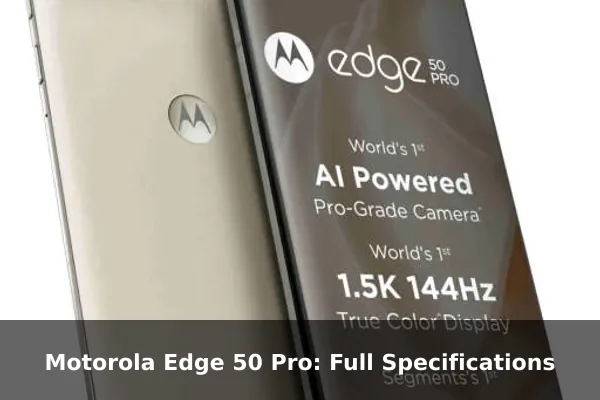
The Motorola Edge 50 Pro is an upper-midrange Android phone built around a strong display, unusually fast charging, and a more flexible camera setup than many phones in its class. It was announced on April 3, 2024 and released on April 8, 2024, placing it in Motorola’s Edge family as a performance-focused alternative to basic midrange models.
This article looks beyond the raw specification sheet to explain what the hardware means in daily use. The dedicated full specifications table will cover the line-by-line details, while this analysis focuses on value, screen quality, chipset behavior, cameras, battery life, software support, and connectivity.
Full Specifications
Network
| Technology: | GSM / HSPA / LTE / 5G |
| 2G bands: | GSM 850 / 900 / 1800 / 1900 |
| 3G bands: | HSDPA 850 / 900 / 1700(AWS) / 1900 / 2100 |
| 4G bands: | 1, 2, 3, 4, 5, 7, 8, 12, 13, 17, 18, 19, 20, 26, 28, 32, 38, 39, 40, 41, 43, 48, 66 |
| 5G bands: | 1, 2, 3, 5, 7, 8, 20, 26, 28, 38, 40, 41, 66, 77, 78 SA/NSA/Sub6 |
| Speed: | HSPA, LTE (CA), 5G |
Launch
| Announced: | 2024, April 03 |
| Status: | Available. Released 2024, April 08 |
Body
| Dimensions: | 161.2 x 72.4 x 8.2 mm (6.35 x 2.85 x 0.32 in) |
| Weight: | 186 g (6.56 oz) |
| Build: | Glass front, plastic back or silicone polymer back (eco leather), aluminum frame |
| SIM: | Nano-SIM + eSIMNano-SIM + Nano-SIM |
| IP68 dust tight and water resistant (immersible up to 1.5m for 30 min) |
Display
| Type: | P-OLED, 1B colors, 144Hz, HDR10+, 2000 nits (peak) |
| Size: | 6.7 inches, 107.4 cm2 (~92.0% screen-to-body ratio) |
| Resolution: | 1220 x 2712 pixels, 20:9 ratio (~446 ppi density) |
| Protection: | Corning Gorilla Glass (unspecified version) |
Platform
| OS: | Android 14, up to 3 major Android upgrades |
| Chipset: | Qualcomm SM7550-AB Snapdragon 7 Gen 3 (4 nm) |
| CPU: | Octa-core (1×2.63 GHz Cortex-A715 & 4×2.4 GHz Cortex-A715 & 3×1.8 GHz Cortex-A510) |
| GPU: | Adreno 720 |
Memory
| Card slot: | No |
| Internal: | 128GB 8GB RAM, 256GB 8GB RAM, 256GB 12GB RAM, 512GB 12GB RAM |
| UFS 2.2 |
Main Camera
| Triple: | 50 MP, f/1.4, 25mm (wide), 1/1.55″, 1.0µm, multi-directional PDAF, OIS 10 MP, f/2.0, 67mm (telephoto), 1/3.94″, 1.0µm, PDAF, OIS, 3x optical zoom 13 MP, f/2.2, 16mm, 120˚ (ultrawide), 1/3.0″, 1.12µm, PDAF |
| Features: | Laser AF, LED flash, panorama, HDR |
| Video: | 4K@30fps, 1080p@30/60/120/240fps, 10-bit HDR10+, gyro-EIS |
Selfie camera
| Single: | 50 MP, f/1.9, 21mm (wide), 0.64µm, AF |
| Features: | HDR |
| Video: | 4K@30fps, 1080p@30/60fps |
Sound
| Loudspeaker: | Yes, with stereo speakers |
| 3.5mm jack: | No |
| Snapdragon Sound |
Comms
| WLAN: | Wi-Fi 802.11 a/b/g/n/ac/6e, tri-band, Wi-Fi Direct |
| Bluetooth: | 5.4, A2DP, LE |
| Positioning: | GPS, GLONASS, GALILEO, BDS, QZSS, NavIC |
| NFC: | Yes |
| Radio: | No |
| USB: | USB Type-C 3.1, OTG, DisplayPort 1.4 |
Features
| Sensors: | Fingerprint (under display, optical), accelerometer, gyro, proximity, compass |
| Smart Connect (Ready For) support |
Battery
| Type: | Li-Po 4500 mAh |
| Charging: | 125W wired, 100% in 18 min 50W wireless 10W reverse wireless |
Misc
| Colors: | Luxe Lavender, Black Beauty, Moonlight Pearl, Vanilla Cream |
| Models: | XT2403-2 |
| SAR: | 1.08 W/kg (head) 1.08 W/kg (body) |
| Price: | € 395.06 / $ 499.00 / £ 296.37 / ₹ 27,483 |
Our Tests
| Performance: | AnTuTu: 842798 (v10) GeekBench: 3083 (v6) 3DMark: 1477 (Wild Life Extreme) |
| Display: | 1295 nits max brightness (measured) |
| Loudspeaker: | -24.6 LUFS (Very good) |
| Battery: | Active use score 11:59h |
Price and Availability
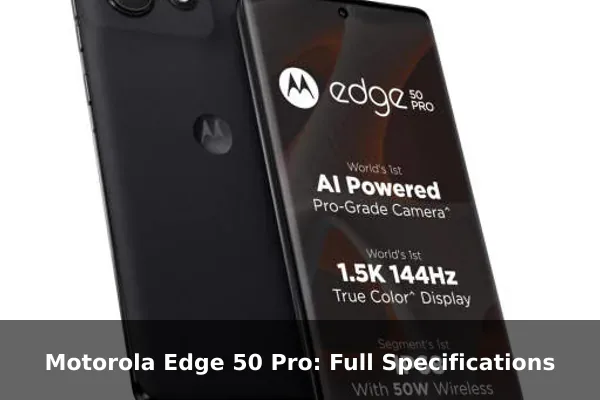
The Motorola Edge 50 Pro offers a compelling combination of features and performance. While the base price is around €395, the actual cost may vary depending on your location and retailer. Below, you’ll find the approximate price of the Motorola Edge 50 Pro converted into various currencies. Please note that these are estimates based on recent exchange rates as of August 3, 2026 and may not reflect the exact price you’ll find at a retailer.
- United States: $456
- Japan: ¥72,006
- United Kingdom: £338
- Australia: A$647
- Canada: C$639
- Taiwan: NT$14,718
- Denmark: kr2.948
- Saudi Arabia: ﷼1,709
- South Korea: ₩654,923
- Germany: €395
- Brazil: R$2.302
- Vietnam: ₫11.899.002
- Kenya: KSh 58,800
- India: ₹43,370
- Indonesia: Rp 8.196.698
- Nigeria: ₦618,098
- Pakistan: ₨126,510
- Philippines: ₱27,895
- Bangladesh: ৳৫৬,২০৭
Why Should You Buy the Motorola Edge 50 Pro?
The Edge 50 Pro is strongest when judged as a balanced phone rather than as a pure gaming handset or a camera flagship. Its main appeal is that it combines a premium-feeling 6.7-inch pOLED display, Snapdragon 7 Gen 3 silicon, IP68 protection, a telephoto camera, wireless charging, and USB-C display output in one package. Those features are often split across different models in this segment, so the Edge 50 Pro stands out as a phone for buyers who want a broad feature set without moving all the way to an ultra-premium device.
Its measured results also support that positioning. The listed AnTuTu v10 score of 842,798 and GeekBench 6 score of 3,083 point to fast everyday performance, while the 11:59h active use score suggests respectable endurance. The value question depends on local pricing and promotions, but the hardware mix is clearly aimed at buyers who care about more than just chipset speed.
Design and Build
Motorola gives the Edge 50 Pro a slim curved-body profile at 161.2 x 72.4 x 8.2 mm and 186 g. That weight is moderate for a 6.7-inch phone, and the aluminum frame helps it feel more refined than phones that rely entirely on plastic side rails. The rear material depends on version, with either plastic or silicone polymer eco-leather style finishes, so grip and texture can vary by color.
The IP68 rating is a major practical advantage. It means the phone is dust tight and rated for immersion up to 1.5 m for 30 minutes under controlled conditions. That does not make it indestructible, but it does add confidence for rain, accidental splashes, and everyday travel. SIM support is market dependent, with Nano-SIM, eSIM, and dual Nano-SIM configurations appearing in the source data.
Display Quality
The display is one of the phone’s defining features. The 6.7-inch pOLED panel uses a 1220 x 2712 resolution, which is sharper than standard FHD+ and reaches about 446 ppi. It also supports 1 billion colors, HDR10+, and a 144Hz refresh rate. Motorola’s official material describes the panel as Pantone Validated, which is relevant for users who care about color consistency in photos, shopping, and social content.
The peak brightness claim is 2000 nits, while the measured maximum brightness in the provided test data is 1295 nits. That distinction matters: manufacturer peak brightness claims are usually measured in limited conditions, while independent or lab-style readings are often more useful for real outdoor visibility. Either way, this is a bright, sharp display with a high refresh ceiling for smooth scrolling and supported games.
Performance and Gaming
The Snapdragon 7 Gen 3 is a 4 nm chipset with an octa-core CPU and Adreno 720 graphics. It is not positioned as a top Snapdragon 8-series chip, but it is efficient and quick enough for heavy multitasking, social apps, photo editing, navigation, and mainstream gaming. The available memory options range from 8GB to 12GB of RAM, paired with 128GB, 256GB, or 512GB of internal storage depending on market and configuration.
The biggest storage caveat is the absence of a microSD card slot. Buyers who record a lot of 4K video, download offline media, or keep large game libraries should choose storage carefully at purchase. UFS 2.2 storage is adequate, but not the fastest standard available in newer premium phones, so the Edge 50 Pro prioritizes balanced performance over benchmark-leading storage throughput.
Camera System
The rear camera system is more versatile than a typical wide-plus-ultrawide midrange setup. It includes a 50MP main camera with optical image stabilization, a 10MP telephoto camera with 3x optical zoom and OIS, and a 13MP ultrawide camera with autofocus. The presence of a real telephoto lens is important because it gives the phone better portrait and zoom flexibility than models that rely only on digital cropping.
The main camera’s f/1.4 aperture is unusually bright on paper, which should help with light gathering and subject separation. Video support includes 4K at 30fps and 1080p up to 240fps, along with 10-bit HDR10+ and gyro-EIS. The 50MP selfie camera also supports autofocus and 4K recording, making the phone more attractive for video calls, vlogging, and creator-style front-camera use.
Battery and Charging
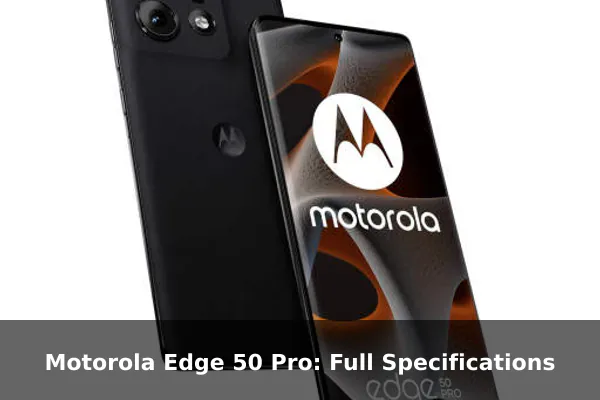
The 4500 mAh battery is not the largest in the Android market, but Motorola offsets that with very fast charging. The source data lists 125W wired charging with a 100% claim in 18 minutes, plus 50W wireless charging and 10W reverse wireless charging. This charging combination is a major reason to consider the Edge 50 Pro over phones that offer larger batteries but slower refill times.
Battery life should still be viewed realistically. The provided active use score is 11:59h, which is solid but not class-leading for endurance-focused buyers. Heavy camera use, 5G, high brightness, and 144Hz refresh behavior can all reduce runtime. The phone is best for users who value quick top-ups and wireless charging convenience as much as maximum battery capacity.
Software and Updates
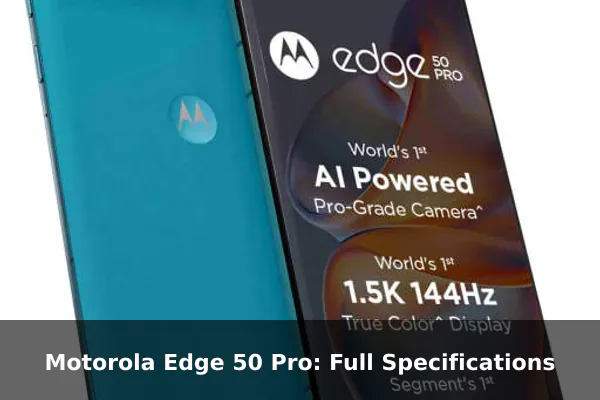
The Edge 50 Pro ships with Android 14 and Motorola’s modern software experience. The source data lists up to three major Android upgrades, while Motorola’s regional support page describes three years of OS upgrades and four years of security maintenance releases. Update timing can still vary by country, carrier, and model variant, so buyers should check the local Motorola support channel before purchasing.
Motorola’s software advantage is usually its lighter Android feel, gesture features, and PC-style connectivity tools rather than aggressive visual customization. Smart Connect, also known through Motorola’s Ready For ecosystem, is especially useful if you want to mirror apps, connect to a monitor, or use the phone more like a compact productivity device.
Connectivity and Extras
Connectivity is comprehensive for the category. The Edge 50 Pro supports GSM, HSPA, LTE, and sub-6 5G, with a wide set of 4G and 5G bands listed in the source data. It also includes Wi-Fi 6E, Bluetooth 5.4, NFC, broad satellite positioning support, and USB Type-C 3.1 with OTG and DisplayPort 1.4. That DisplayPort support is a notable extra for users who connect to monitors, docks, or travel displays.
Audio features include stereo speakers and Snapdragon Sound, but there is no 3.5 mm headphone jack. The loudspeaker result of -24.6 LUFS is rated very good in the provided test data, so speaker output should be strong for casual media playback. The under-display optical fingerprint sensor keeps the front design clean, while the sensor package covers the expected motion and navigation features.
Who Should Buy It?
The Motorola Edge 50 Pro is a strong fit for buyers who want a bright curved display, fast charging, IP68 protection, a capable main camera, and a true telephoto lens without paying for a top-tier flagship. It also suits users who connect their phone to external displays, because USB-C 3.1 with DisplayPort 1.4 is still not guaranteed across all midrange phones.
It is less ideal for buyers who need expandable storage, a headphone jack, or the longest possible battery life. Serious mobile gamers may also prefer a Snapdragon 8-series phone for higher sustained graphics performance. For everyone else, the Edge 50 Pro is best understood as a polished all-rounder with unusually strong charging and display credentials.
References
- Motorola Support: moto edge 50 pro specifications
- Qualcomm Snapdragon mobile platform product information
- PhoneArena: Motorola Edge 50 Pro specifications
Conclusion
The Motorola Edge 50 Pro is a well-rounded Android phone with a premium display, practical IP68 build, fast wired and wireless charging, flexible cameras, and useful connectivity extras. Its lack of microSD expansion and headphone jack should be considered, but the overall package is competitive for buyers who want a refined upper-midrange phone. Recommended for users who value display quality, charging speed, and camera versatility in one device.
