
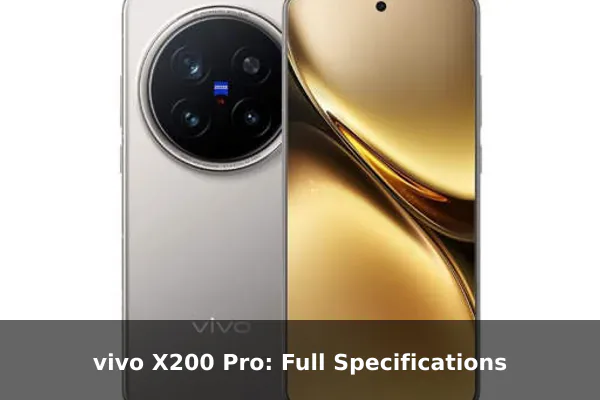
The vivo X200 Pro arrives as the imaging flagship of vivo’s 2024 lineup, pairing a MediaTek Dimensity 9400 processor with a ZEISS-tuned triple camera built around a headline 200 MP periscope telephoto. Announced on October 14, 2024 and released days later, it targets buyers who want a compact-footprint flagship that still delivers long-reach zoom, a 6000 mAh battery, and full IP68/IP69 durability.
Positioned below the X200 Ultra but well above mainstream mid-rangers, the X200 Pro is one of those rare phones that leans into photography without sacrificing endurance or everyday polish. This article looks past the raw spec sheet to explain what the numbers mean in practice, how the phone compares to rivals, and who it is actually for.
Full Specifications
Network
| Technology: | GSM / HSPA / LTE / 5G |
| 2G bands: | GSM 850 / 900 / 1800 / 1900 |
| 3G bands: | HSDPA 800 / 850 / 900 / 1700(AWS) / 1900 / 2100 – China |
| HSDPA 850 / 900 / 1700(AWS) / 1900 / 2100 – International | |
| 4G bands: | 1, 2, 3, 4, 5, 7, 8, 12, 17, 18, 19, 20, 26, 28, 32, 34, 38, 39, 40, 41, 42, 66 – International |
| 1, 2, 3, 4, 5, 7, 8, 18, 19, 20, 26, 28, 34, 38, 39, 40, 41, 66 – China | |
| 5G bands: | 1, 2, 3, 5, 7, 8, 12, 20, 25, 26, 28, 38, 40, 41, 66, 77, 78 SA/NSA/Sub6 – India |
| 1, 3, 5, 7, 8, 20, 26, 28, 38, 40, 41, 66, 75, 77, 78, 79 SA/NSA/Sub6 – Malaysia | |
| 1, 3, 5, 8, 28, 38, 40, 41, 77, 78, 79 SA/NSA/Sub6 – China | |
| Speed: | HSPA, LTE, 5G |
Launch
| Announced: | 2024, October 14 |
| Status: | Available. Released 2024, October 19 |
Body
| Dimensions: | 162.4 x 76 x 8.2 mm or 8.5 mm |
| Weight: | 223 g or 228 g (7.87 oz) |
| Build: | Glass front, aluminum alloy frame, glass back or glass fiber back |
| SIM: | Nano-SIM + Nano-SIM + eSIM (max 2 at a time)Nano-SIM + Nano-SIM |
| IP68/IP69 dust tight and water resistant (high pressure water jets; immersible up to 1.5m for 30 min) |
Display
| Type: | LTPO AMOLED, 1B colors, 120Hz, 2160Hz PWM, HDR10+, Dolby Vision, 4500 nits (peak) |
| Size: | 6.78 inches, 111.5 cm2 (~90.3% screen-to-body ratio) |
| Resolution: | 1260 x 2800 pixels, 20:9 ratio (~452 ppi density) |
| Protection: | Scratch/drop-resistant glass (Armor Glass) |
| Ultra HDR image support |
Platform
| OS: | Android 15, up to 4 major Android upgrades, Funtouch 15 (International), OriginOS 5 (China) |
| Chipset: | Mediatek Dimensity 9400 (3 nm) |
| CPU: | Octa-core (1×3.63 GHz Cortex-X925 & 3×3.3 GHz Cortex-X4 & 4×2.4 GHz Cortex-A720) |
| GPU: | Immortalis-G925 |
Memory
| Card slot: | No |
| Internal: | 256GB 12GB RAM, 512GB 16GB RAM, 1TB 16GB RAM |
| UFS 4.0 |
Main Camera
| Triple: | 50 MP, f/1.6, 23mm (wide), 1/1.28″, 1.22µm, PDAF, OIS 200 MP, f/2.7, 85mm (periscope telephoto), 1/1.4″, 0.56µm, multi-directional PDAF, OIS, 3.7x optical zoom, macro 2.7:1 50 MP, f/2.0, 15mm, 119˚ (ultrawide), 1/2.76″, 0.64µm, AF |
| Features: | Laser AF, color spectrum sensor, Zeiss optics, Zeiss T* lens coating, LED flash, panorama, HDR, 3D LUT import |
| Video: | 8K@30fps, 4K@30/60/120fps, 1080p@30/60/120/240fps, gyro-EIS, 10-bit Log, Dolby Vision HDR |
Selfie camera
| Single: | 32 MP, f/2.0, 20mm (ultrawide) |
| Features: | HDR |
| Video: | 4K@30/60fps, 1080p@30/60fps |
Sound
| Loudspeaker: | Yes, with stereo speakers |
| 3.5mm jack: | No |
| 24-bit/192kHz Hi-Res audio |
Comms
| WLAN: | Wi-Fi 802.11 a/b/g/n/ac/6/7, dual-band |
| Bluetooth: | 5.4, A2DP, LE, aptX HD, LHDC 5 |
| Positioning: | GPS (L1+L5), GLONASS (L1), BDS (B1I+B1c+B2a+B2b), GALILEO (E1+E5a+E5b), QZSS (L1+L5), NavIC (L5) |
| NFC: | Yes |
| Infrared port: | Yes |
| Radio: | No |
| USB: | USB Type-C 3.2, OTG |
Features
| Sensors: | Fingerprint (under display, ultrasonic), accelerometer, gyro, proximity, compass |
| Satellite connectivity support (optional, market/region dependent) |
Battery
| Type: | Si/C Li-Ion 6000 mAh (Global)Li-Ion 5200 mAh (Austria, Hungary, Germany) |
| Charging: | 90W wired 30W wireless Reverse wired |
Misc
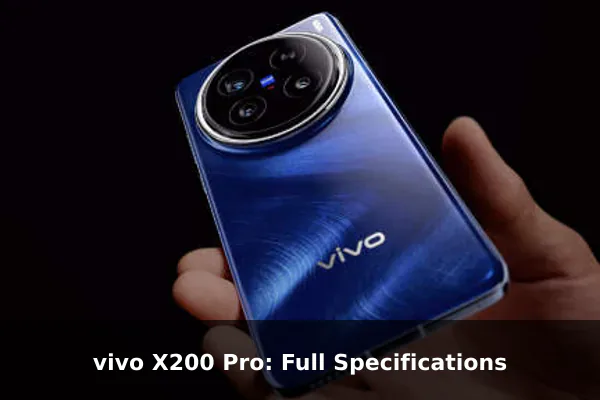
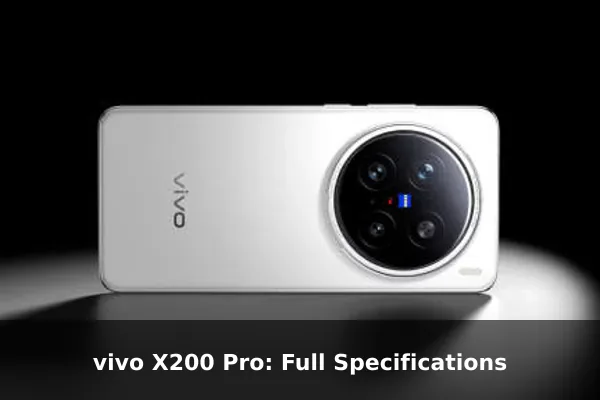
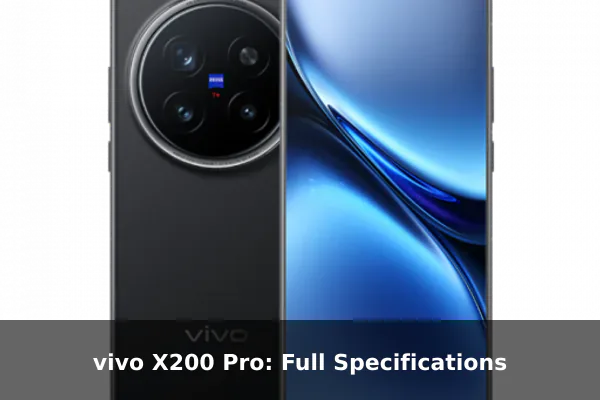
| Colors: | Cosmos Black, Titanium Grey, Blue, White |
| Models: | V2413, V2405A, V2405DA |
| SAR: | 0.99 W/kg (head) 0.90 W/kg (body) |
| Price: | € 1,099.00 / $ 799.00 / ₹ 87,950 |
Our Tests
| Performance: | AnTuTu: 2609095(v10) GeekBench: 8152 (v6) 3DMark: 6173 (Wild Life Extreme) |
| Display: | 1881 nits max brightness (measured) |
| Loudspeaker: | -25.0 LUFS (Very good) |
| Battery: | Active use score 15:09h |
Price and Availability
The vivo X200 Pro offers a compelling combination of features and performance. While the base price is around €1.099, the actual cost may vary depending on your location and retailer. Below, you’ll find the approximate price of the vivo X200 Pro converted into various currencies. Please note that these are estimates based on recent exchange rates as of July 14, 2026 and may not reflect the exact price you’ll find at a retailer.
- United States: $1,253
- Japan: ¥203,304
- United Kingdom: £937
- Australia: A$1,808
- Canada: C$1,772
- Taiwan: NT$40,299
- Denmark: kr8.203
- Saudi Arabia: ﷼4,697
- South Korea: ₩1,877,084
- Germany: €1.099
- Brazil: R$6.423
- Vietnam: ₫32.802.447
- Kenya: KSh 162,231
- India: ₹1,19,868
- Indonesia: Rp 22.673.457
- Nigeria: ₦1,717,117
- Pakistan: ₨348,352
- Philippines: ₱77,234
- Bangladesh: ৳১,৫৪,৫১৪
Value: Where the X200 Pro Sits
Launching around € 1,099 / $ 799 / ₹ 87,950, the X200 Pro is priced as a proper flagship rather than a bargain, though its Indian pricing in particular undercuts several Western rivals. What you are paying for is a combination that is hard to find elsewhere at this level: a 200 MP periscope telephoto, a 6000 mAh silicon-carbon battery, and IP69 rating in a body that stays under 8.5 mm thick. Against competitors like the Samsung Galaxy S24 or Google Pixel 9 Pro already on this site, the vivo differentiates itself on zoom reach and battery capacity rather than software ecosystem, making it a strong choice for value-focused enthusiasts.
Design and Build Quality
The X200 Pro measures 162.4 x 76 x 8.2 mm (8.5 mm on the glass-fiber variant) and weighs 223–228 g, so it is substantial but not unwieldy for a large-battery flagship. vivo uses a glass front, an aluminum alloy frame, and either a glass or glass-fiber back, finished in Cosmos Black, Titanium Grey, Blue, and White. The standout is protection: IP68 and IP69 ratings mean it resists dust, sustained immersion up to 1.5 m for 30 minutes, and even high-pressure, high-temperature water jets. That IP69 certification is still uncommon on phones and gives the X200 Pro genuine peace-of-mind durability.
Display Experience
The 6.78-inch LTPO AMOLED panel is a highlight, running at 1260 x 2800 resolution (~452 ppi) with a 120Hz adaptive refresh rate and 2160Hz PWM dimming to reduce eye strain. It supports HDR10+ and Dolby Vision, and vivo quotes a 4500-nit peak brightness; independent testing measured around 1881 nits in real use, which is more than enough for confident outdoor visibility. With Ultra HDR image support and Armor Glass protection, this is a display tuned for both media and photography review, comfortably competitive with the best in this class.
Performance and Software
Powering the phone is MediaTek’s 3 nm Dimensity 9400, an octa-core chip led by a 3.63 GHz Cortex-X925 core and paired with the Immortalis-G925 GPU. Benchmark results back up the flagship billing: AnTuTu around 2.6 million, GeekBench 6 multi-core near 8152, and a 3DMark Wild Life Extreme score of 6173. Memory options run from 256GB/12GB up to 1TB/16GB on fast UFS 4.0 storage, though there is no microSD slot. On the software side it ships with Android 15 (Funtouch 15 internationally, OriginOS 5 in China) and promises up to four major Android upgrades, giving it a reasonable, if not class-leading, support window.
Camera System
Photography is the X200 Pro’s reason for being. The triple ZEISS-tuned array combines a 50 MP f/1.6 wide with OIS, a 200 MP f/2.7 periscope telephoto offering 3.7x optical zoom and macro capability, and a 50 MP ultrawide with autofocus. ZEISS T* lens coating, a color spectrum sensor, and laser AF round out the hardware, while video tops out at 8K@30fps with 4K up to 120fps, 10-bit Log, and Dolby Vision HDR. The 200 MP telephoto is the differentiator here, delivering the kind of detailed long-range and portrait shots that most flagships in this price bracket cannot match. A 32 MP ultrawide selfie camera handles the front, capturing 4K video.
Battery and Charging
The global model packs a 6000 mAh Si/C Li-Ion battery (a smaller 5200 mAh cell ships in Austria, Hungary, and Germany), and it shows in endurance testing, with an active-use score of roughly 15 hours. Charging is handled by 90W wired and 30W wireless, plus reverse wired output, so top-ups are quick even if the wired figure trails some rivals. For buyers who prioritize all-day, even two-day, stamina without a bulky phone, this battery-and-efficiency pairing is one of the X200 Pro’s strongest arguments.
Connectivity and Extras
Connectivity is comprehensive: Wi-Fi 7, Bluetooth 5.4 with aptX HD and LHDC 5, multi-band GNSS positioning, NFC, an infrared port, and USB Type-C 3.2 with OTG. Broad 5G band coverage spans India, Malaysia, and China variants, and vivo lists optional satellite connectivity depending on market. An ultrasonic under-display fingerprint sensor, stereo speakers measured at a very good -25.0 LUFS, and 24-bit/192kHz Hi-Res audio complete a well-rounded package, even though there is no 3.5mm jack or FM radio.
Who Should Buy the vivo X200 Pro
The X200 Pro suits mobile photographers who want serious zoom reach, media lovers who value a bright HDR display, and anyone who prioritizes battery life and rugged IP69 durability. It is less ideal for buyers locked into a specific software ecosystem or those who need the longest possible OS-update guarantee. If flexible cameras and endurance top your list, it delivers exceptional value; if brand ecosystem or resale matters more, cross-shopping the Samsung and Google alternatives on this site is worthwhile.
Conclusion
The vivo X200 Pro is a focused, confident flagship that leads with camera versatility and battery endurance rather than chasing every checkbox. Its 200 MP ZEISS periscope, 6000 mAh cell, bright LTPO display, and IP69 build make it a compelling pick for photography and durability-minded buyers, especially at its competitive pricing. As always, confirm current pricing, availability, and regional variants through official vivo channels before buying, but for enthusiasts who want zoom and stamina in one package, the X200 Pro comes highly recommended.
References
- vivo Global Official Website – Official manufacturer site; primary source for verified specifications, features, and product details of the vivo X200 Pro.
- vivo X200 Pro Official Product Page (vivo.com) – Official product page listing authoritative technical specs (display, chipset, camera, battery, charging). URL left empty to avoid fabricating an exact path.
- GSMArena – Established, widely trusted phone specifications database used for cross-checking detailed hardware specs and dimensions.
- MediaTek Dimensity 9400 Product Page – Official chipset maker page to verify the SoC (Dimensity 9400) powering the X200 Pro, including CPU/GPU and process details.
- ZEISS Camera Collaboration – Official ZEISS site to confirm the co-engineered optics and imaging features marketed on the vivo X200 Pro camera system.
